
Your car is wrecked beyond repair — and you don’t have insurance to cover it. No payout is coming, the repair shop just quoted more than the car is worth, and now you’re stuck with a dead vehicle and no safety net. Take a breath: you’re not out of options. Thousands of drivers end up in this exact spot every year, and a totaled car with no insurance still has real cash value. This guide walks through exactly what ‘totaled’ means for an uninsured driver, your four realistic options, what the wreck is still worth, and the fastest way to turn it into cash.
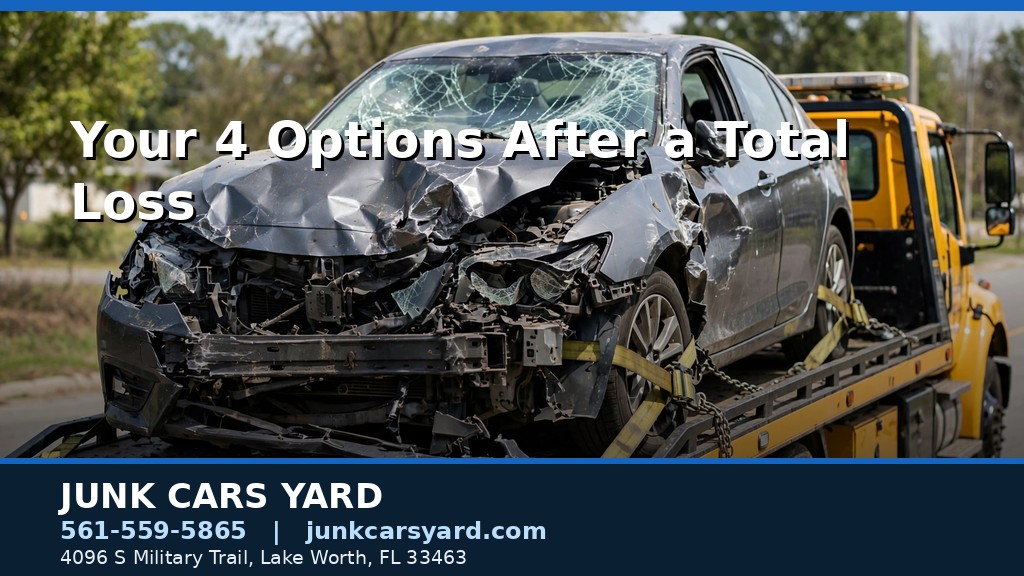
What ‘Totaled’ Means When You Have No Insurance
A car is ‘totaled’ when repairing it costs more than the vehicle is worth — the point where fixing it makes no financial sense. With insurance, the insurer declares the total loss and pays you the car’s value. Without insurance, there’s no declaration and no check — just you, a wrecked car, and a repair estimate that’s higher than the car’s market value. The practical meaning is the same, though: the car isn’t worth fixing. What surprises most uninsured drivers is that ‘not worth fixing’ doesn’t mean ‘worth nothing.’ The wreck still holds salvage value — undamaged parts, recyclable steel, and components that survived the crash. Learn more about how we buy totaled cars
Why Having No Insurance Changes Everything
With no insurance, three things hit differently. First, there’s no settlement check — every dollar of the loss comes out of your pocket, which makes recovering maximum value from the wreck itself critical. Second, you’re the one making all the decisions: no adjuster, no rental car, no guidance — just you figuring out what to do with a dead car. Third, if you were financing the car, the loan doesn’t disappear with the wreck — you still owe the lender, and now you have no car and no insurance payout to cover it. That last point is the one that blindsides people: the lender gets paid regardless. Selling the wreck for its full salvage value becomes the fastest way to put a dent in what you owe.
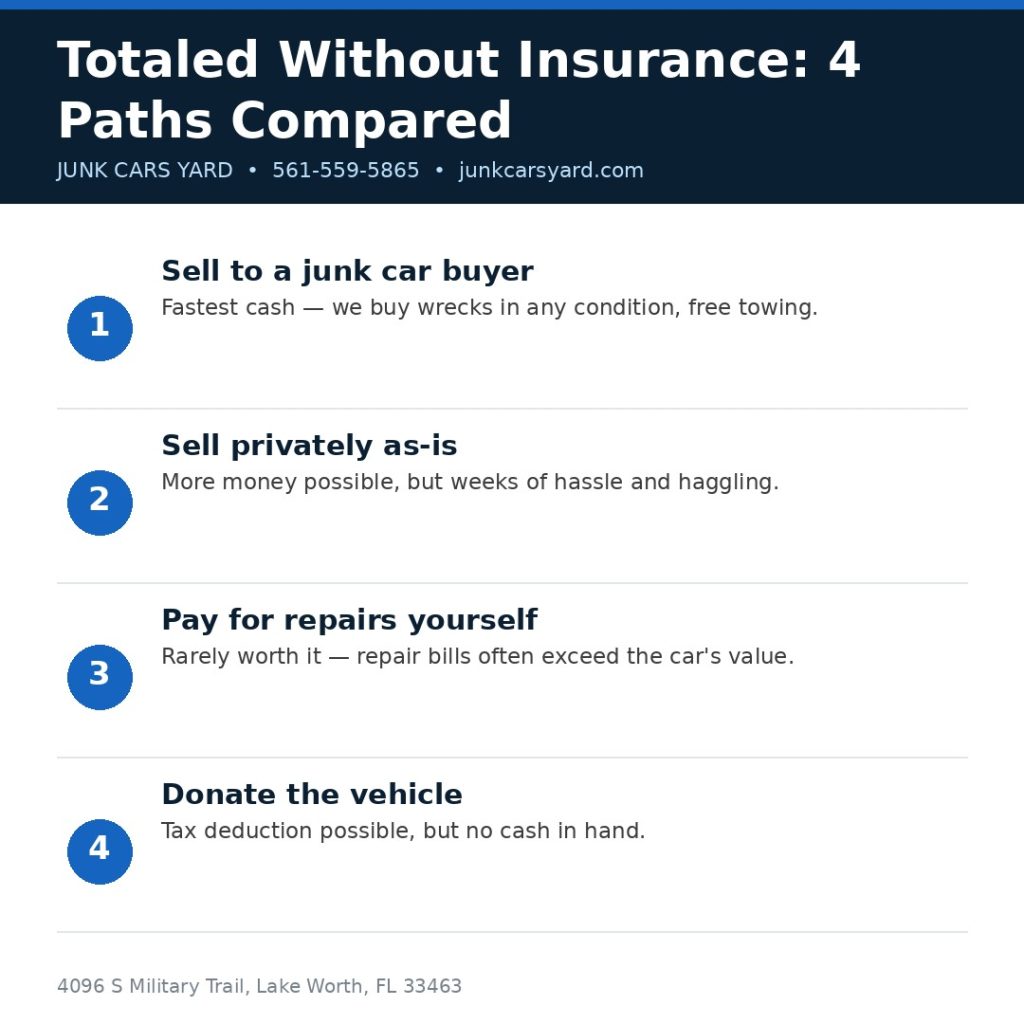
Your 4 Options, Compared Honestly
Here are the realistic paths, with no sugarcoating:
| Option | How it works | Best when | Watch out for |
|---|---|---|---|
| Sell to a junk car buyer | We pay cash and tow it free, same day | You want the fastest clean exit with cash in hand | Get quotes from 2-3 buyers so you know your number is fair |
| Repair out of pocket | You pay a shop to fix it yourself | Damage is light and the car has real remaining value | Repair bills spiral — get a written estimate first and compare against the car’s fixed value |
| Sell privately as-is | List the wreck for sale yourself | The car is a desirable model with light damage | Weeks of tire-kickers, haggling, and buyers who flake |
| Donate it | A charity tows it free | You itemize deductions and the car has low value | No cash in hand — and the deduction is limited to what the charity actually sells it for |
For most uninsured drivers with a genuinely totaled car, option one wins: it’s the only path that puts cash in your hand today with zero additional spending. Still on the fence? Our guide on whether you should sell your car to a junkyard breaks down when it’s the right move.
What Your Totaled Car Is Still Worth
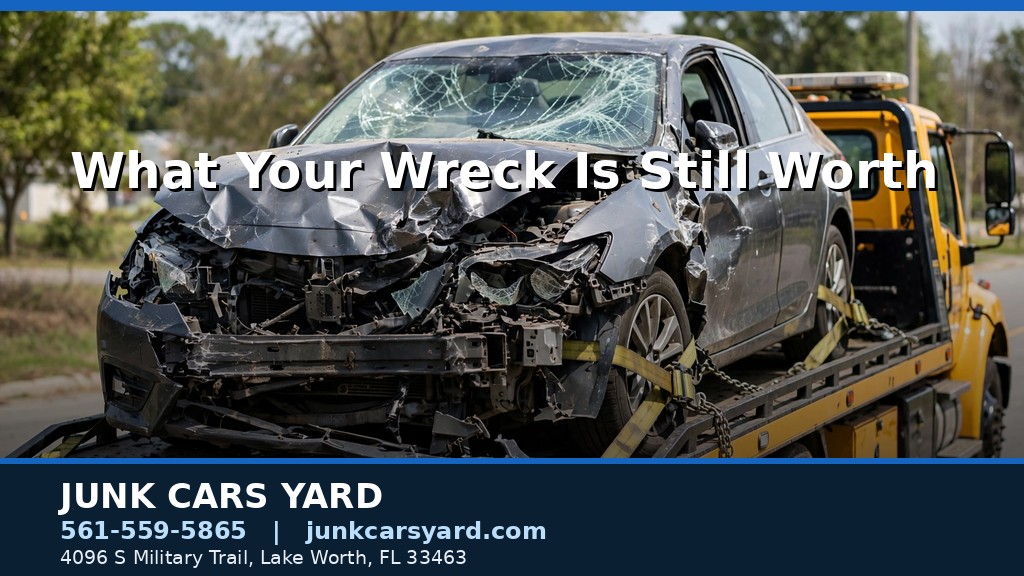
Salvage value depends on five things. First, year, make, and model — newer and popular vehicles carry more valuable surviving parts. Second, what’s undamaged: a rear-ended car with a clean front end, good interior, and intact wheels still holds strong parts value. Third, the drivetrain: if the engine and transmission survived, they’re among the most valuable used components in Florida. Fourth, weight — the steel shell alone has scrap value, and heavier vehicles start higher. Fifth, the catalytic converter: intact converters are consistently valuable regardless of crash damage. The single biggest mistake uninsured sellers make is assuming the car is worthless and letting it sit — or worse, paying a tow yard storage fees while they decide. Every week of indecision costs money. Call 561-559-5865 for a straight cash offer based on what’s actually there.
Getting a real number for your wreck is simpler than most people expect, and it costs nothing. A reputable junk car buyer only needs the basics: year, make, model, and an honest description of the damage — especially which parts of the car are untouched and whether anything still runs. A few clear photos make the quote more accurate: shoot the damaged areas, but also the clean panels, the interior, the wheels, and under the hood if it opens. Mention anything valuable that survived the crash — a running engine, a straight frame on the undamaged side, good tires with tread left, or an intact catalytic converter — because those are the details that move your number upward. Be honest about the bad stuff too; a buyer who discovers surprises at pickup may revise the offer, while one who quoted on accurate information will honor the number. When you call around, pay attention to how the quote is given: a firm cash number beats a vague range, and a buyer who guarantees free towing beats one who mentions fees later. Two or three calls take less than half an hour and give you a clear picture of what your car is actually worth — exactly the leverage you need when you’re negotiating without an insurance adjuster in your corner.
Timing matters more than most sellers realize, because a wreck loses value sitting still. A car parked in a driveway or on the street can draw HOA complaints and code-enforcement notices, and in some neighborhoods that means daily fines. If the car is sitting at a tow yard or a repair shop, storage fees accumulate every single day while you decide — fees that come straight out of the value you could have recovered. Florida’s climate works against you too: heat and humidity mildew interiors, corrode electronics, and let fluids leak onto the ground, all of which eat into the parts value that sets your price. The quote you get this week reflects the car’s condition this week; next month’s quote reflects next month’s condition. On the paperwork side, keep it simple: the certificate of title is the main document, and you’ll sign it over to the buyer at pickup — take a photo of the signed title for your own records before handing it across. If the title is lost, Florida’s HSMV 82050 process exists for exactly this situation, and an experienced local buyer can walk you through it. After the sale, file the Notice of Sale and return your plate to the tax collector’s office. That paper trail — bill of sale, filed notice, returned plate — is what closes your liability on the vehicle for good.
When a buyer looks at your totaled car, they’re doing quick math on what’s recoverable. They’ll check which body panels are straight, whether the airbags deployed, if the frame is bent, and what the interior looks like. A car that looks destroyed from the outside can still have a clean engine bay, good seats, and working electronics — and that’s where the value lives. This is why photos matter: clear pictures of all four sides, the interior, and the engine bay let a buyer quote accurately without guessing.
Don’t be surprised if quotes vary between buyers. Different yards have different needs — one might be short on parts for your specific model, while another already has three of them. That’s not a reason to distrust the process; it’s a reason to get those two or three quotes and pick the strongest one. The key is that every legitimate quote should be free, with no obligation, and should include free towing. If anyone asks you to pay for the tow or the quote, that’s your sign to call someone else.
Step-by-Step: Selling Your Totaled Car Without Insurance
- Get the title in hand. You’ll need the certificate of title (or work through Florida’s HSMV 82050 no-title process — our no-title guide).
- Remove your belongings and plates. Clear out personal items, toll transponders, and garage openers. In Florida, the plate stays with you — return it to the tax collector’s office.
- Take photos of the damage. Document everything — useful if any insurance or legal questions come up later, and it helps buyers quote accurately.
- Get 2-3 cash quotes. Call junk car buyers (including us at 561-559-5865) and compare. A real buyer quotes free with no obligation.
- Pick your buyer and schedule free pickup. We pay cash on the spot and tow free — most pickups happen the same day you call.
- File Form HSMV 82050 (Notice of Sale). This tells Florida you no longer own the vehicle and cuts off your liability for tickets, tolls, and anything else — our HSMV 82050 guide
What If You Still Owe Money on the Car?
The loan survives the wreck. Contact your lender immediately, explain the situation, and ask about your options — some lenders will work with you on the remaining balance once the car is sold for salvage. This is where getting top salvage value matters most: every extra dollar from the wreck is a dollar off what you still owe. If you have gap insurance (sometimes buried in finance paperwork), check — it may cover the difference between the car’s value and the loan balance. Either way, don’t let the wreck sit racking up storage fees while the loan bills keep coming.
5 Mistakes That Cost Uninsured Drivers Money
- Letting the car sit for months while deciding — storage fees, HOA fines, and deterioration eat the value.
- Paying for a repair estimate on a clearly totaled car — if the damage is obviously beyond the car’s value, skip the paid diagnosis.
- Forgetting the HSMV 82050 — liability for tolls and tickets follows the registered owner until the state is notified.
- Leaving the plates on the wreck — return them; in Florida they’re yours, not the car’s.
- Taking the first lowball offer in a panic — two or three free quotes take twenty minutes and can change the number significantly.
Frequently Asked Questions
Can I sell a totaled car without insurance?
Yes — insurance has nothing to do with your right to sell your own car. You need the title (or Florida’s no-title process) and a photo ID. We buy totaled cars from uninsured owners every week.
Will the accident show up and hurt my sale price?
A totaled car is priced on salvage value, not clean history — the accident is already baked in. What’s undamaged (parts, drivetrain, converter, weight) is what sets your number.
Should I repair it myself without insurance?
Only if the damage is genuinely light and a written repair estimate comes in well under the car’s fixed value. For truly totaled cars, repairs almost always exceed the value — that’s what ‘totaled’ means.
What if the car is financed and I have no insurance?
You still owe the lender. Sell the wreck for its full salvage value to reduce the balance, contact the lender about the remainder, and check your finance paperwork for gap insurance.
How fast can you pick up my totaled car?
Often the same day you call. Call 561-559-5865 early in the day for the fastest pickup — and stop any storage fees immediately.
Do I need to notify anyone after selling?
Yes — file Florida’s HSMV 82050 Notice of Sale and return your license plate to the tax collector’s office. That closes your liability on the vehicle.
Turn Your Total Loss Into Cash Today
No insurance, no payout — but your wreck still has value, and we’ll pay it. Junk Cars Yard buys totaled cars across Palm Beach County in any condition: collision, flood, fire, or mechanical total loss. One call to 561-559-5865 gets you a straight cash offer, free towing, and same-day pickup. See exactly how our process worksDon’t let a total loss become a total waste — get your cash.