
You’ve got a dead car and a tempting thought: what if I strip it for parts and sell everything piece by piece? You’ve seen engines sell for real money online, and the math looks exciting — until you price in your weekends. Parting out a car CAN pay more than selling it whole. It can also eat a month of your life for less than minimum wage. This guide breaks down what parting out actually involves, the real math, the hidden hassles nobody mentions, and exactly when each choice wins — so you pick the profitable path, not the painful one.

What Parting Out Actually Involves
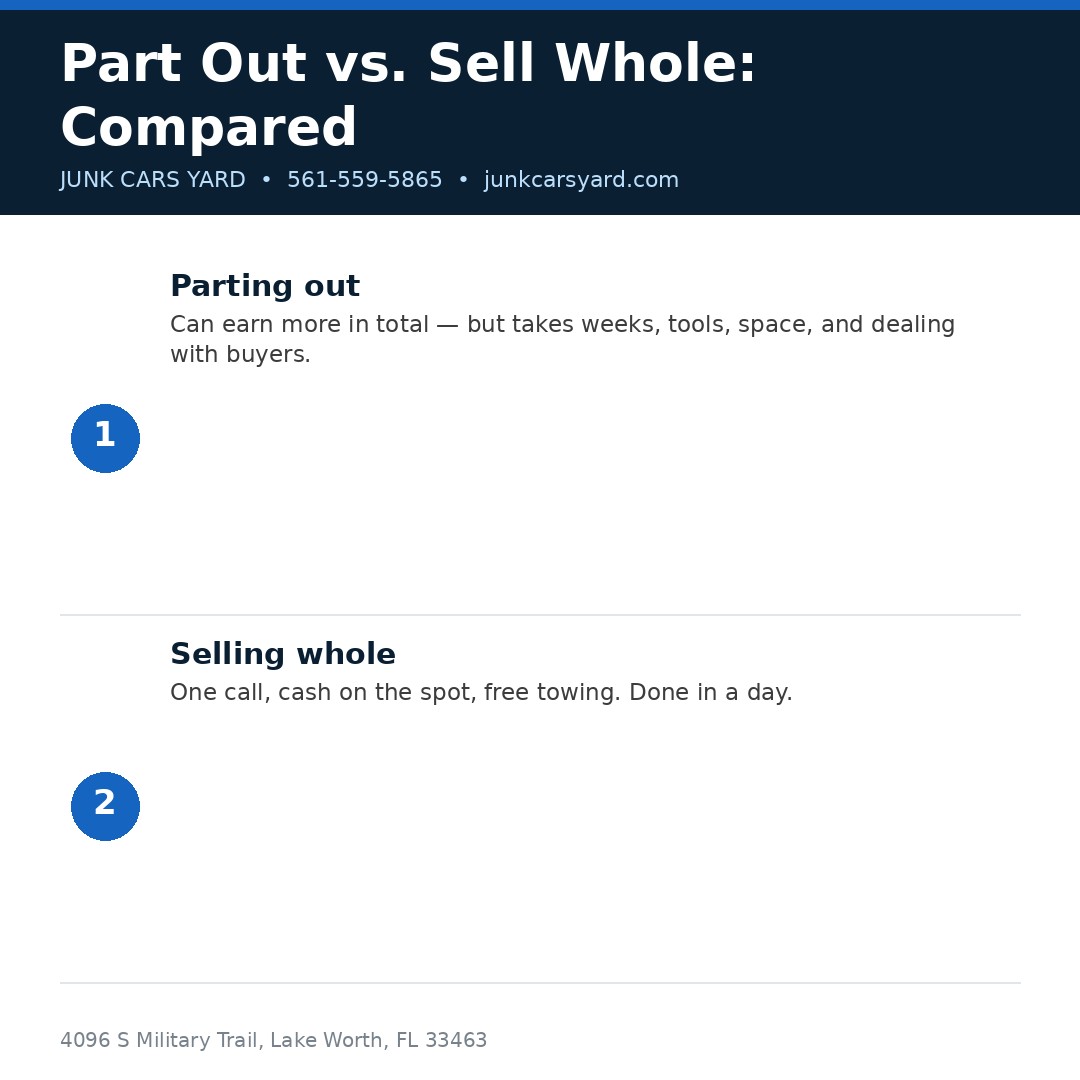
Parting out means dismantling your car yourself and selling the components individually — engine, transmission, doors, lights, seats, wheels, catalytic converter, electronics — usually through online marketplaces. In theory, the sum of the parts exceeds the whole: buyers pay retail-ish prices for the specific part they need, while a junk buyer pays wholesale for the entire car. In practice, parting out is a part-time job. You’re the mechanic, the photographer, the lister, the shipper, the customer service rep, and the disposer of whatever’s left. Before you commit, understand the full job description.
The Real Math: Can You Make More?
Yes — sometimes significantly. A car worth a modest whole-car price might yield more in parts IF several things are true: the car is a popular model with strong parts demand (Honda, Toyota, Ford trucks); major components are in good working order (running engine, good transmission); you can remove parts without damaging them; and you actually follow through on listing, selling, and shipping everything. But the math most people do is wrong — they add up best-case part prices and forget the subtractions: marketplace fees, shipping costs, tools you need to buy, fluids disposal, and the biggest one, your time. An honest calculation: (likely part revenue) minus (fees + shipping + supplies + disposal) divided by (your hours) = your real hourly wage. For many people, that number is sobering.
There is also the question of what your time is worth to you specifically. If you earn a solid wage at your day job or run a business, every Saturday spent under the car carries an opportunity cost that is easy to ignore but very real. That is time not spent earning, resting, or being with your family. Parting out only looks like a windfall when your hours are valued at zero — and nobody’s time is worth zero. Before you commit, total the hours honestly and ask whether you would accept a second job at that effective rate.
Then there is the sales funnel nobody models honestly. Not every part sells, and almost nothing sells at the first asking price. Engines and transmissions may find buyers quickly, but doors, seats, mirrors, and trim pieces can sit listed for months while the car still occupies your driveway. A realistic forecast counts only the parts that move quickly at fair prices — not the fantasy total of every nut and bolt at top dollar. The gap between “listed for” and “actually sold for” is where most part-out budgets quietly die.
Another cost people forget is the cost of the shell itself. Even if you sell every valuable part, the stripped carcass still has to go somewhere. Towing a hulk without wheels costs money, and junk buyers pay less for a stripped shell than for a complete car — sometimes much less. If you cannot move it yourself, you are paying for removal out of the very profit you worked weeks to earn. Factor the shell’s reduced value into your forecast from the start, not as an afterthought.
Finally, be honest with yourself about follow-through. Most part-outs do not fail because the math was wrong — they fail because motivation runs out. The first weekend is fun: the big parts come off and the listings go up. By week five, you are answering the same questions about a fender while tripping over boxes in your garage. If you have unfinished projects sitting around your house right now, a part-out will probably join them. Selling whole has one unbeatable feature: it is finished today.
Mileage and age tilt the math further. A high-mileage engine or a car that has sat exposed for years will attract weaker demand and lower offers, while the labor to remove the parts stays exactly the same. Sellers often price parts based on listings for low-mileage donor cars, then discover buyers will not pay anything close for a tired unit. When your donor car is rough, the “sell whole” column usually wins by a wider margin than people expect.
What Parting Out Really Takes
Check yourself against this list before you start:
- Time: expect 20-60 hours across several weeks — removal, cleaning, photographing, listing, messaging buyers, packaging, shipping, and meetups.
- Tools: engine hoist for heavy components, full socket sets, jacks and stands — buying what you lack eats into profit.
- Space: a driveway or garage you can sacrifice for weeks, plus somewhere to store removed parts. HOAs often prohibit dismantling vehicles visibly.
- Knowledge: you need to remove parts without breaking them — a cracked dashboard or cut wiring harness is worthless.
- Buyers: you’ll deal with no-shows, hagglers, returns, and ‘is this still available’ messages at midnight.
- The shell: after the good parts are gone, you still have a stripped hulk to dispose of — which usually means calling a junk buyer anyway, for less.
The Hidden Hassles Nobody Mentions
Beyond the obvious work, parting out brings surprises. Hazardous fluids — oil, coolant, transmission fluid, refrigerant — must be drained and disposed of properly; dumping them is illegal and the disposal isn’t free. Large parts need freight shipping or local pickup only, which shrinks your buyer pool. Small parts sell slowly: that door handle might take three months to move. Meanwhile the half-stripped car sits in your driveway drawing HOA letters and neighbor complaints. And every week the leftover shell sits, its scrap value drops as weather and vandals take their toll. The most common part-out story isn’t a triumph — it’s a carcass abandoned mid-project.
Then there is the buyer side of the hassle. Marketplace buyers are not dealership customers. They will message you at midnight, offer half your asking price, schedule pickups and vanish, and occasionally damage a part while removing it themselves — then blame you for it. If you ship parts, you are now running a small logistics operation: boxes, padding, labels, post office runs, and the occasional damaged-in-transit claim. Every transaction costs you attention, the one resource most part-out planners never put in the budget.
Do not underestimate the driveway problem either. A car on jack stands with its hood off is an eyesore, and in many neighborhoods it is also a code violation waiting to happen. HOAs move fast when a project car appears, and if you rent, your landlord may not allow vehicle dismantling at all. Once deadline pressure starts — a move-out date, an HOA fine, a storm rolling in — the remaining parts get sold for pennies or hauled off as scrap, and the extra profit you were chasing evaporates with them.
Safety deserves a mention too. Parting out means working under a lifted vehicle, handling sharp sheet metal, draining flammable fluids, and dealing with airbag modules that can still deploy if mishandled. Professional dismantlers have lifts, training, and insurance; a driveway does not. One injury or one fuel spill turns a money-saving project into a very expensive day.
There is also the paperwork tail. In Florida, the shell’s title still has to be transferred or surrendered properly, even after every part is gone. Lose the title mid-project and you have added a DMV errand to your to-do list. Keep every document where you can find it, because the final step of every part-out is a legal one.
Finally, there is the simple reality that a part-out never really ends on your schedule. The last few parts — the odd brackets, wiring connectors, and interior trim — can linger for months, and the longer they sit, the longer your garage stays a warehouse. At some point most sellers quietly donate or trash the leftovers just to reclaim their space. Count only the money you realistically expect to collect before your patience runs out.
When Parting Out Makes Sense
Parting out wins when: you have mechanical skills and already own the tools; you have free garage space and no HOA watching; the car is a high-demand model with a running drivetrain; you genuinely enjoy the work (some people do!); and you have the weeks to spare. The sweet spot is a popular car with one fatal flaw — say, a wrecked body but a perfect engine and transmission. Pull the drivetrain, sell it, then sell the shell whole. That’s the hybrid approach, and it’s often the smartest version of parting out.
When Selling Whole Wins
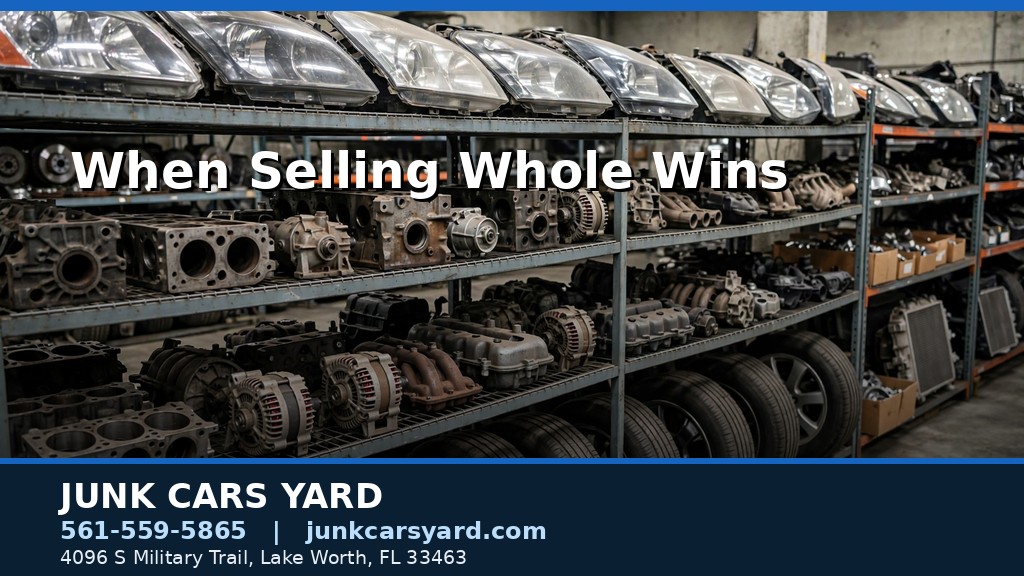
Sell the whole car when: you value your time more than the extra margin; you lack tools, space, or mechanical confidence; the car is a low-demand model (parts won’t move); the car is heavily damaged, rusted, or flood-damaged (parts value is low anyway); you need it gone this week (HOA pressure, moving, need the driveway); or you’d rather have guaranteed cash today than possible cash over two months. For most people, most of the time, selling whole is the better financial decision once time is priced honestly.
Side-by-Side Comparison
| Factor | Parting out | Selling whole |
|---|---|---|
| Total cash | Often higher (if you finish) | One fair price, guaranteed |
| Time to cash | Weeks to months | Same day |
| Effort | 20-60+ hours of skilled labor | One phone call |
| Upfront cost | Tools, fees, shipping, disposal | Zero |
| Risk | Parts may not sell; shell loses value | None — price agreed before pickup |
| Best for | Skilled DIYers with time and space | Everyone else |
Frequently Asked Questions
- How much more can I make parting out vs selling whole?
It varies enormously by model and condition — popular models with good drivetrains have the biggest gap. But price your hours honestly: divide the extra profit by 20-60 hours and ask if that wage beats just selling whole today. - What’s the most valuable part of a junk car?
Usually the engine and transmission (if working), followed by the catalytic converter, wheels and tires, and body panels on popular models. These are also the hardest to remove and ship. - Can I part out a car without a title?
You can sell parts, but the remaining shell still needs legal disposal — and in Florida, transferring even a shell typically requires title paperwork or the HSMV 82050 process. See our no-title guide. - Do I need a license to part out cars?
Parting out your own car occasionally is generally fine, but doing it repeatedly as a business can trigger dealer/dismantler licensing requirements in Florida. One car in your driveway: fine. Five cars a month: that’s a business. - What do I do with the leftover shell?
Call a junk car buyer — which is what most part-outs end with anyway. We’ll buy stripped shells and remaining hulks; you’ll just get less than if you’d sold the complete car. See how our process works. - How fast can you pick up my whole car?
Often the same day you call. One call to 561-559-5865, a straight cash offer, free towing — done.
Skip the Project — Take the Cash
Parting out is a job disguised as a windfall. Unless you have the skills, tools, space, and weeks to spare, selling whole pays better per hour of your life. Junk Cars Yard buys junk cars whole across Palm Beach County — any condition, cash on the spot, free towing, same-day pickup. Call 561-559-5865 and be done by dinner. If you’re also weighing whether to fix it at all, see repair or sell your old car. Still deciding? Read is it better to junk a car or sell it for the full breakdown.