
Selling an old car should not be complicated.
Maybe the vehicle has been sitting behind the house in Lake Worth, it no longer runs, it was damaged in an accident, or the repair estimate simply stopped making financial sense. You search for a junk car buyer, make a few phone calls, compare offers and arrange a pickup.
The part that deserves more attention is who you are actually selling the vehicle to.
In Florida, there are licensing requirements for businesses that buy, sell or deal in motor vehicles. Florida law also specifically defines a salvage motor vehicle dealer as someone engaged in acquiring salvaged or wrecked vehicles for the purpose of reselling them and their parts.
That does not mean every person who buys an unwanted car is automatically doing something wrong. A private individual selling a vehicle they personally owned is different from someone operating a recurring vehicle-buying business.
The important question for a Lake Worth seller is simple:
Can the buyer clearly explain who they are, what type of business they operate, and how the vehicle sale will be documented?
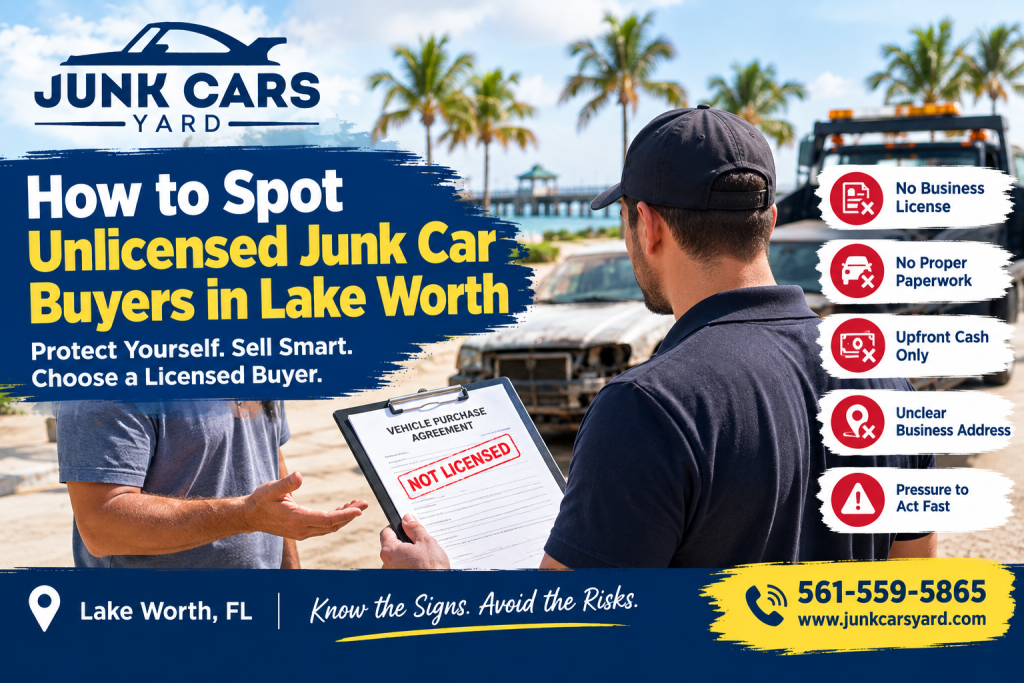
7 signs you should look more closely at a junk car buyer
Before handing over your title, keys or vehicle, watch for these warning signs:
- The buyer refuses to provide business or dealer information.
- They cannot clearly explain who is purchasing the vehicle.
- They want you to sign incomplete paperwork.
- They tell you not to worry about the title or Notice of Sale.
- They ask you to leave your license plate on the vehicle.
- The price changes dramatically when the tow truck arrives.
- They pressure you to make an immediate decision.
None of these signs, by itself, proves that a buyer is unlicensed or acting illegally.
But together, they are good reasons to slow down and verify the transaction before releasing the vehicle.
1. Ask who is actually buying your car
This is the first question I would ask.
Not:
“How much will you pay me?”
Start with:
“What is the legal business name of the company buying my vehicle?”
A legitimate vehicle transaction should not be mysterious.
You should be able to identify the business or purchaser and understand whether you are dealing with a motor vehicle dealer, salvage dealer, towing company, recycler, or private buyer.
Florida’s dealer statute defines a motor vehicle dealer broadly as someone engaged in the business of buying, selling or dealing in motor vehicles. Florida also establishes a presumption that someone buying, selling or dealing in three or more motor vehicles within a 12-month period is engaged in that business.
That is why the distinction between “I am buying my neighbor’s old car” and “I regularly buy vehicles for resale, salvage or parts” matters.
If someone advertises themselves as a professional junk car buyer, it is reasonable to ask for identifying business information.
2. Ask whether the business has the appropriate Florida license
This is where many sellers stop asking questions.
They see a website, a phone number and a promise of cash and assume everything is fine.
Instead, ask:
“What type of Florida dealer or salvage license does your business operate under?”
Florida’s official dealer guidance identifies several dealer license categories, including an Independent Motor Vehicle Dealer and a Salvage Vehicle Dealer.
The correct license category can depend on what the business actually does.
A company buying damaged vehicles for salvage and parts can have different regulatory considerations from a business simply providing towing services.
So don’t judge a buyer solely by whether the words “junkyard” or “junk car” appear in its advertising.
Look at the underlying transaction.
3. Don’t confuse a tow truck with a licensed vehicle buyer
This is an easy mistake.
A towing company can tow your car.
That does not automatically mean the towing company is the business purchasing your vehicle.
Likewise, a salvage yard may handle vehicles for parts or recycling, while another company may arrange the transportation.
If somebody says:
“We’ll tow it away and take care of everything.”
ask one additional question:
“Who will be listed as the purchaser on the vehicle paperwork?”
That answer matters.
You want the paperwork to match the actual transaction.
4. Be careful when a buyer says paperwork is unnecessary
This is one of the biggest red flags.
A junk car can be worth very little, but that does not make the paperwork irrelevant.
Florida’s official HSMV 82050 Notice of Sale and/or Bill of Sale records information such as:
- Vehicle identification number
- Make and model
- Certificate of title information
- Purchaser’s name
- Purchaser’s address
- Date of sale
- Selling price
- Odometer information
- Seller information
- Signatures and certification
The official form also states that it should be submitted to the local tax collector’s office.
So if a buyer tells you:
“You don’t need any paperwork. Just give me the keys.”
take a step back.
A professional sale should not depend on keeping the transaction undocumented.
5. Ask about the Florida HSMV 82050 Notice of Sale
If you are selling a junk car in Lake Worth, HSMV 82050 is a form worth knowing.
Florida’s FLHSMV procedure for marking a vehicle record as sold says that the seller/owner can submit an accurately completed HSMV 82050, or the applicable Notice of Sale section on the certificate of title, to a tax collector’s office or license plate agent.
This does not mean the HSMV 82050 magically transfers ownership by itself.
The official form specifically states that ownership status does not change until the purchaser applies for and receives a certificate of title.
That distinction is important.
A buyer who understands Florida vehicle transactions should be able to discuss the paperwork without acting confused or trying to rush you through it.
If you want the broader process, see our guide on how to sell a junk car.
6. Watch what happens with your license plate
Here’s another detail that gets overlooked when someone is standing beside a tow truck.
Florida law says that when a used or secondhand motor vehicle is sold and delivered, the seller must remove the registration license plate before transferring ownership and delivering the vehicle.
FLHSMV also provides procedures concerning the surrender or handling of plates when a vehicle is disposed of.
So if a buyer tells you:
“Just leave the plate on it.”
don’t automatically accept that instruction.
Ask what you need to do with the plate and confirm the procedure through FLHSMV or your local motor vehicle service provider.
This is particularly important because a license plate remains associated with the seller/registrant until the appropriate process is completed.
7. Be suspicious of a buyer who changes the offer at pickup
This is not specifically a licensing violation.
It is simply a business-practice warning sign.
Imagine you receive a quote for $900.
You arrange the pickup.
The driver arrives and suddenly says:
“We’ll only give you $350.”
Maybe there really is a legitimate issue with the vehicle that wasn’t disclosed.
But if nothing about the car changed and the buyer simply uses the tow truck’s arrival to pressure you, you have every right to stop the transaction.
Before agreeing to a junk car pickup, ask:
“Is this the final purchase price based on the information I provided?”
It is also smart to describe the vehicle honestly:
- Year
- Make
- Model
- Mileage, if known
- Running or non-running
- Accident damage
- Missing parts
- Flood or fire damage
- Condition of the tires
- Whether the title is available
That makes the quote easier to understand.
For more information about valuation, you can also read our 2026 South Florida junk car value guide.
8. Don’t let “cash today” pressure you into skipping verification
“Cash for junk cars” is a common search phrase in Lake Worth.
And there is nothing inherently wrong with wanting to get paid quickly.
The problem starts when speed becomes a reason to skip basic checks.
A buyer saying:
“We can pick it up today.”
is one thing.
A buyer saying:
“Don’t worry about the paperwork. Just sign here and we’ll handle everything.”
is something else.
You can move quickly and document the transaction.
That’s especially useful when selling a vehicle that has been sitting for months and you simply want it gone.
9. Check the buyer’s physical business information
A professional business should generally be able to tell you where it operates.
That doesn’t necessarily mean every junk car transaction happens at a traditional walk-in junkyard.
Some businesses arrange mobile pickup throughout Lake Worth, Lake Worth Beach and Palm Beach County.
Still, ask:
- What is the company name?
- Where is the business located?
- What phone number should I use if there is a problem?
- Who will purchase the vehicle?
- What paperwork will I receive?
- Who will arrange the tow?
- What happens after the vehicle is picked up?
If the answers keep changing, that’s a reason to slow down.
Lake Worth sellers have another reason to deal with junk cars promptly
For homeowners in Lake Worth Beach, an unwanted vehicle isn’t always just an eyesore.
The City of Lake Worth Beach currently lists unlicensed and/or inoperable vehicles on private property among its code-compliance issues. The city also states that vehicles must be operable and registered with current tags, and that keeping an inoperable, unregistered or unlicensed vehicle on residential property is prohibited.
That can matter if an old vehicle is sitting in a driveway, side yard or another residential area.
It is one reason homeowners around areas such as Downtown Lake Worth, Bryant Park, Tropical Ridge, Parrot Cove, College Park and Lake Osborne Heights may eventually decide that keeping an unwanted vehicle around is more trouble than it is worth.
If you’re dealing with a vehicle that has already become a property or code-compliance issue, our guide on selling a junk car without a title in Lake Worth may also be useful.
What about ZIP codes 33460, 33461, 33463 and 33467?
The Lake Worth area covers several ZIP codes, and junk-car situations can look different depending on where the vehicle is located.
For example, a seller may be dealing with an old vehicle near:
- 33460 — central Lake Worth/Lake Worth Beach areas
- 33461 — areas around Lake Worth Beach and Palm Springs
- 33463 — areas around South Military Trail and surrounding communities
- 33467 — western Lake Worth-area neighborhoods
The important thing isn’t the ZIP code itself.
It’s making sure the buyer knows where the vehicle is, what condition it is in and what documents you have before agreeing to the pickup.
That is especially important for non-running cars, vehicles with flat tires, wrecked vehicles and cars that cannot safely be driven.
What should a licensed junk car buyer be willing to explain?
A good transaction should not feel like a guessing game.
Before you agree to sell, you should be able to get clear answers to questions such as:
Who is buying the vehicle?
You should know the purchaser or purchasing business.
What happens to the title?
The title should be handled according to Florida requirements.
What paperwork will be completed?
Ask about the bill of sale, Notice of Sale and other documents that apply to your transaction.
What happens to the license plate?
Florida law requires removal of the registration plate when a used vehicle is sold and delivered.
Is the quoted price final?
Ask before scheduling pickup.
Who is responsible for transportation?
Clarify whether the buyer provides junk car removal or whether you are expected to arrange towing separately.
What happens if the vehicle doesn’t run?
A legitimate buyer should be able to tell you whether they handle non-running, wrecked or damaged vehicles.
Can I sell a junk car without a title?
This is one of the questions we hear frequently.
The answer depends on the circumstances and the documentation available for the vehicle.
Don’t assume that a missing title means you should hand the vehicle over to the first person who says they will take it.
A buyer who immediately says:
“No title? No problem. Just sign this blank paper.”
should make you uncomfortable.
Instead, explain the situation and ask what documentation is required.
For Lake Worth-specific information, see our full guide on how to sell a junk car without a title in Lake Worth, FL.
What if the car is wrecked, flooded or missing parts?
A damaged vehicle can still have value.
A buyer may evaluate:
- Engine
- Transmission
- Catalytic converter
- Wheels and tires
- Body panels
- Interior components
- Electronics
- Reusable mechanical parts
- Scrap metal
- Vehicle make and model
- Current demand for parts
Florida’s definition of a salvage motor vehicle dealer specifically covers businesses acquiring salvaged or wrecked vehicles for resale and their parts.
So don’t assume that a car has to be running to have value.
A wrecked Honda, Toyota, Ford, Chevrolet, Nissan, Hyundai or other vehicle can have useful components even when the vehicle itself is no longer practical to repair.
You can learn more about the parts side of the business on our used auto parts page.
A simple Lake Worth junk car buyer checklist
Before handing over your vehicle, run through this list:
Buyer verification
☐ I know the buyer’s business name.
☐ I know who is purchasing the vehicle.
☐ I can ask about the appropriate Florida dealer/salvage licensing.
☐ I know how to contact the business after pickup.
Vehicle paperwork
☐ I have my title if available.
☐ The VIN matches the vehicle and paperwork.
☐ The sale price is documented.
☐ Required odometer information is handled.
☐ I understand the Notice of Sale process.
License plate
☐ I know what to do with my Florida license plate.
☐ I am not simply leaving the plate on the vehicle because someone told me to.
Pickup
☐ The vehicle condition was accurately described.
☐ The agreed price is clear.
☐ I understand who is providing towing/removal.
☐ I am not being pressured into signing incomplete documents.
If everything is clear, the transaction becomes much easier.
How to verify information if you are unsure
If something about a buyer doesn’t look right, you don’t have to make the decision on the spot.
You can check official Florida resources and contact the Florida Highway Safety and Motor Vehicles (FLHSMV) regarding dealer licensing, complaints and motor vehicle procedures. FLHSMV identifies its Bureau of Dealer Services as the office handling dealer licenses, complaints and dealer investigations.
For vehicle records, FLHSMV also provides a Vehicle Information Check that can be searched using a title number or VIN.
And when you’re dealing with title or sale paperwork, it’s better to verify the procedure with FLHSMV or the appropriate Palm Beach County tax collector/license plate agent than to rely solely on advice from a buyer.
What about Junk Cars Yard?
At Junk Cars Yard, our focus is straightforward: help Lake Worth-area vehicle owners understand their options when they have an unwanted, damaged, wrecked or non-running vehicle.
We provide junk car removal and purchase services in the Lake Worth area and surrounding Palm Beach County communities.
That includes situations where a vehicle has been sitting unused, suffered major damage, stopped running or simply isn’t worth repairing.
If you’re ready to compare your options, you can start with our main sell your junk car page or learn more about selling a junk car for cash in Florida.
The goal should not simply be to get a car off your property.
The goal is to know who you’re dealing with, understand the paperwork and complete the sale properly.
Frequently Asked Questions
How can I tell if a junk car buyer in Lake Worth is licensed?
Ask the buyer for its business identity and the applicable Florida motor vehicle dealer or salvage dealer licensing information. Florida law regulates businesses engaged in buying, selling or dealing in motor vehicles, with specific provisions for salvage motor vehicle dealers.
Is every person buying an old car required to have a dealer license?
Not necessarily. Florida law contains exceptions for certain people disposing of vehicles acquired for their own use or business, among other circumstances. The important distinction is whether the person is operating a vehicle-buying business covered by the dealer licensing requirements.
Should I give my license plate to the junk car buyer?
Florida law requires the seller to remove the registration plate before transferring ownership and delivering a used or secondhand vehicle.
What is HSMV 82050?
HSMV 82050 is Florida’s Notice of Sale and/or Bill of Sale form. It records important details about the vehicle, purchaser, seller, sale date, price and odometer disclosure. FLHSMV instructs sellers to submit the form to their local tax collector office.
Can a junk car buyer pick up my non-running vehicle?
Many junk car buying services are designed to handle vehicles that cannot be driven. When arranging pickup, tell the buyer whether the vehicle runs, rolls, steers and has usable tires so the appropriate equipment can be sent.
Should I accept a blank title or incomplete paperwork?
No. Do not sign documents you do not understand or leave important sections blank simply because someone says they’ll “fill it in later.” If you’re unsure, stop and verify the correct Florida procedure.
Final Thoughts for Lake Worth Car Owners
Selling a junk car doesn’t have to be stressful.
Whether your vehicle is sitting in 33460, 33461, 33463 or 33467, the basic idea is the same: know who you’re selling to, ask reasonable questions, verify the applicable credentials, document the transaction and handle the title and license plate correctly.
A professional buyer should not be offended because you want to protect yourself.
In fact, those are exactly the questions worth asking before the tow truck arrives.
And if a buyer refuses to answer simple questions about the business, paperwork or purchase process, you don’t have to rush.
Take a few minutes. Verify the details. Then decide.