
When you’re settling a loved one’s affairs in Florida, the car in the driveway becomes your problem — and selling a deceased person’s vehicle isn’t like selling your own. Florida law says only someone with legal authority can sign over the title, and signing the deceased owner’s name yourself is forgery, even with the best intentions. The process is manageable once you know the steps. This guide covers who can legally sell the car, whether probate is required, every document you’ll need, and the fastest way to convert that vehicle into cash for the estate. (General information only — not legal advice. For complex estates, check with the county clerk or a Florida probate attorney.)
Who Can Legally Sell a Deceased Person’s Car in Florida?
Florida doesn’t let just anyone sell a dead person’s car — even family. Legal authority comes from one of these:
- The personal representative (executor) named in the will, once appointed by the probate court
- A surviving co-owner, if the title was held jointly with rights of survivorship
- An heir or beneficiary with a court order (for example, through summary administration)
- A court-appointed administrator if there was no will
What you can’t do: sign the deceased person’s name on the title yourself, have a family member sign ‘for’ them, or sell the car and sort out paperwork later. Buyers — including junk car buyers like us — need a clean, legal signature chain, or the transfer won’t hold. If you’re not sure you have authority yet, call us at 561-559-5865 and we’ll tell you exactly what we’ll need to see.
Does the Car Have to Go Through Probate?
Not always. It depends on the estate:
- Formal probate: for larger estates, the court appoints a personal representative who gets ‘letters of administration’ — the document proving they can sell estate property, including the car.
- Summary administration: Florida’s simplified process for smaller estates. If the estate qualifies, a court order can authorize the transfer without full probate — often faster and cheaper.
- No probate needed: if the vehicle was jointly owned with rights of survivorship, the surviving owner typically needs only a certified death certificate to retitle and sell.
Cars are often the simplest asset in an estate. Many families are surprised that the vehicle can transfer while the rest of probate is still ongoing. Ask the county clerk’s office or the estate’s attorney which path applies — then the car part is usually straightforward.
Documents You’ll Need to Sell the Car
Gather these before you start — and for the standard sale checklist, see what paperwork you need to sell a junk car in Florida:
- The certificate of title — check exactly whose names appear on it
- A certified copy of the death certificate
- Letters of administration or order of summary administration (if probate applies)
- Your valid government photo ID
- A lien satisfaction letter (if a car loan was paid off but the lien still shows)
- Duplicate title application (if the original title is lost)
Florida title offices (county tax collector offices acting for FLHSMV) handle the transfer paperwork. Having everything in one folder before you go saves a second trip. If you’re unsure how to fill out the title itself, see how to sign a Florida car title before you go.
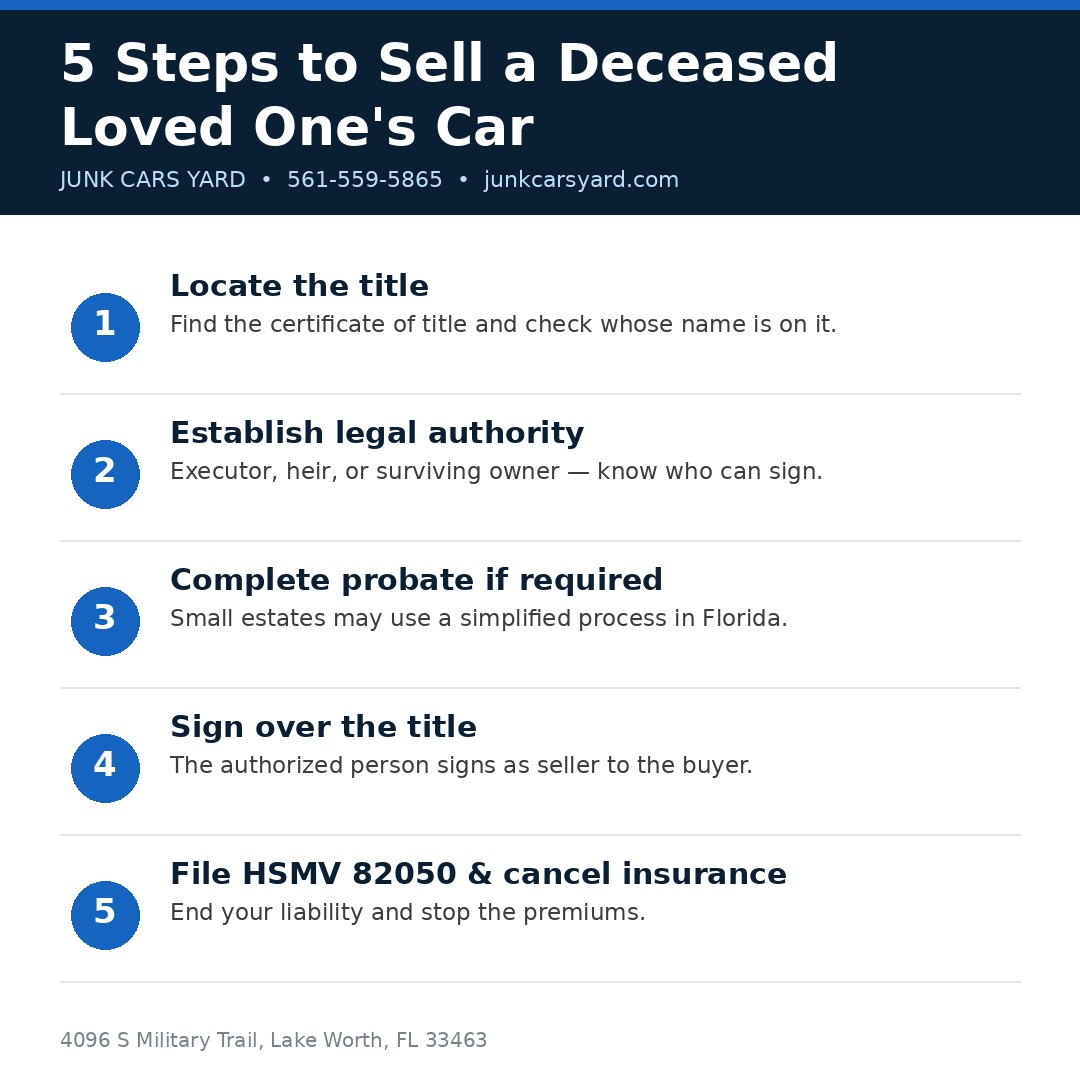
Step-by-Step: Selling a Deceased Loved One’s Car
- Find the title. Check the front for owner names — ‘John Smith OR Jane Smith’ vs ‘John Smith AND Jane Smith’ matters. ‘OR’ means either owner could sell; ‘AND’ means both signatures were required.
- Confirm your authority. Match your situation to the list above — executor with letters, surviving joint owner, or court order.
- Clear any lien. Contact the lender for a payoff amount and lien release if a loan existed.
- Replace a lost title if needed. Apply for a duplicate through the tax collector’s office with the death certificate and your authority documents.
- Sign as the authorized seller. You sign YOUR name, indicating your capacity (e.g., ‘Jane Smith, Personal Representative of the Estate of John Smith’) — never the deceased’s name.
- Complete a bill of sale. Record the buyer, price, date, and VIN.
- File Form HSMV 82050 (Notice of Sale). This tells the state you no longer own the vehicle and cuts off your liability — see our guide to the HSMV 82050.
- Cancel the insurance and surrender the plate. Return the license plate to the tax collector’s office and cancel the policy to stop premiums.
What If There’s Still a Loan on the Car?
If the deceased still owed money on the vehicle, the lienholder gets paid first. Contact the lender with the death certificate — they’ll tell you the payoff amount and their process. Then do the math: if the car is worth more than the payoff, sell it and the estate keeps the difference. If the loan exceeds the car’s value (common with older financed cars), the estate may need to cover the gap or negotiate with the lender. A junk car buyer can still purchase a lienholder-encumbered vehicle in some cases, but the lien must be released for a clean transfer — talk to us and we’ll walk through your specific situation.
What If the Title Is Lost?
Lost titles are common with estate vehicles — paperwork gets scattered during a difficult time. In Florida, the authorized person can apply for a duplicate certificate of title at the county tax collector’s office. Bring the certified death certificate, your photo ID, and your letters of administration or court order. There’s a small fee, and the duplicate typically arrives by mail. Alternatively, if you’re selling to us, call 561-559-5865 first — in many Florida cases
we can work with the HSMV 82050 Notice of Sale process even when the original title can’t be found — see our no-title guide.
What Happens to the License Plate and Registration?
In Florida, the license plate belongs to the owner, not the car — so when the owner passes, the plate should be surrendered to the county tax collector’s office. Don’t leave the deceased’s plate on the car, and don’t transfer it to your own vehicle without going through the proper process. Return the plate in person, get a receipt, and keep it with the estate records. Canceling the registration at the same time stops future renewal notices and confirms with the state that the vehicle is no longer on the road under the deceased’s name. If you’re selling the car to us, we’ll remind you about the plate at pickup — it’s one of the most commonly forgotten steps.
Typical Timeline: How Long Does the Whole Process Take?
Every estate moves at its own pace, but here’s what families usually experience:
| Step | Typical timeframe |
|---|---|
| Locating the title and documents | 1–7 days |
| Establishing legal authority (no probate needed) | 1–3 days |
| Summary administration (if needed) | 2–6 weeks |
| Formal probate appointment (if needed) | 4–12 weeks |
| Duplicate title by mail (if lost) | 1–3 weeks |
| Sale to a junk car buyer once ready | Same day |
The car sale itself is the fastest part — it’s the paperwork that sets the pace. Starting the document hunt early saves weeks.
Your Selling Options Compared
Once you have authority, how you sell affects speed, effort, and price:
| Method | Junk car buyer | Private sale | Dealer trade-in |
|---|---|---|---|
| Speed | Same-day pickup | Weeks to months | 1–2 days |
| Effort | One phone call | Listings, showings, haggling | Negotiation |
| Best for | Older, damaged, or non-running cars | Newer cars in good shape | Buying another car there |
| Paperwork help | We guide you through it | You’re on your own | Dealer handles it |
| Payment | Cash on the spot | Varies (risk of scams) | Applied to new purchase |
For estate vehicles that are older, haven’t run in months, or need work, a junk car buyer is usually the fastest clean exit — one call, cash on the spot, free towing, and we handle the transfer paperwork with you.
5 Mistakes That Delay (or Derail) the Sale
- Signing the deceased owner’s name — it’s forgery, even with permission from family.
- Selling before authority is established — the transfer can be voided.
- Skipping the HSMV 82050 — liability for tickets and tolls can follow the estate.
- Leaving insurance active — premiums keep billing until you cancel.
- Letting the car sit for months — HOA violation letters, dead batteries, flat-spotted tires, and nesting rodents all reduce what the car is worth.
Why Estate Cars Lose Value Sitting Idle
Every month an estate car sits, it costs the estate money and loses value. Insurance premiums keep billing until you cancel. Batteries die, tires flat-spot, fuel goes stale, and in Florida’s humidity, mold takes hold in interiors fast. HOA communities may also fine the estate for inoperable vehicles sitting in driveways. A car worth a solid cash offer today can become a nearly worthless hulk after six months of sitting. Selling promptly isn’t just convenient — it protects the estate’s money.
Frequently Asked Questions
Can I sell a deceased person’s car without probate in Florida?
Sometimes. If the car was jointly owned with rights of survivorship, the surviving owner can usually transfer it with just a death certificate. Otherwise, you’ll typically need either summary administration or formal probate authority. Check with the county clerk for your situation.
The title says ‘AND’ between two names and one owner died. Now what?
The surviving owner generally can’t sell alone on an ‘AND’ title — the deceased owner’s interest must pass through the estate (will or probate) before the survivor holds clear title. An ‘OR’ title is simpler: the survivor can act alone.
How long does it take to sell an estate car?
With documents in hand, selling to a junk car buyer takes a day — call, quote, pickup, cash. The paperwork side (probate, duplicate title) is what takes time: from days for simple cases to weeks if court involvement is needed.
Do I need the death certificate to junk a car?
If you’re selling as the estate’s authorized representative, yes — we’ll need to see it along with your authority documents. It protects everyone by proving the chain of ownership.
Will you buy a car if the estate never got the title transferred?
Call us at 561-559-5865 and describe the situation. In many Florida cases we can work with the HSMV 82050 process and the estate’s authority documents. Every situation is different, so we’ll tell you straight what we can do.
Can I drive the deceased person’s car while the estate is being settled?
Only with proper insurance in place — and the estate’s personal representative should authorize it. Driving an uninsured vehicle, or one whose registration lapsed, creates liability for the estate. If nobody needs the car, the safest move is to park it, keep insurance current until the sale, and sell promptly.
What if multiple heirs disagree about selling the car?
All legal heirs generally need to agree, or the personal representative decides under their court-granted authority. Disagreements can stall the sale for months while the car loses value sitting idle. If you’re the personal representative, document the car’s condition and get a written cash offer — a firm number often settles debates fast. Call 561-559-5865 for a no-obligation quote you can show the family.
The car has unpaid tolls and tickets. Who pays?
Tolls and tickets attached to the vehicle typically stay with the estate, not the buyer — another reason to file the HSMV 82050 Notice of Sale the day you sell. That filing draws a clean line: anything after the sale date isn’t the estate’s problem. Unpaid tolls from before the sale may come out of the estate’s proceeds.
Turn the Estate Car Into Cash Today
Settling an estate is stressful enough — the car shouldn’t add to it. Junk Cars Yard buys estate and probate vehicles across Palm Beach County in any condition: running or not, with titles or working through Florida’s no-title process. One call to 561-559-5865 gets you a straight cash offer, free towing, and help with the transfer paperwork. see how our process works. Let us take the car off your hands — and put money back into the estate.