
If you have an old car sitting in your driveway, behind your house, in a private parking area, or on a local street in Lake Worth, it may be time to decide what you are going to do with it.
A vehicle that once served as a daily driver can eventually become something very different: a car that no longer runs, a wrecked vehicle waiting for repairs, a rusted sedan that has been sitting for years, or an unwanted SUV taking up valuable driveway space.
That situation has received increased attention in Lake Worth because of the city’s efforts to address abandoned and inoperable vehicles.
Local reporting by WPTV described Lake Worth’s red-tag program, which targets abandoned and inoperable vehicles, including vehicles that are dismantled, missing parts, have flat tires, are wrecked, lack active registration, or are visibly unsafe to drive. WPTV reported that the city had red-tagged more than 900 cars since February at the time of its report.
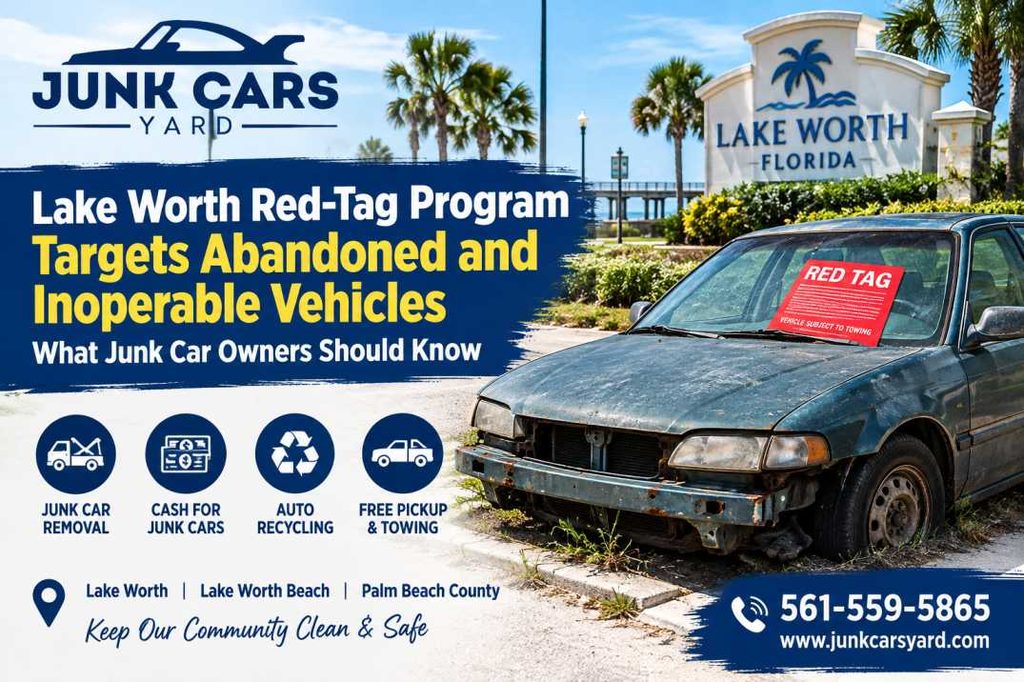
For local homeowners, the bigger question is practical:
What should you do if you have a junk car that you no longer want or cannot reasonably repair?
For some vehicle owners, the answer may be to repair the vehicle and bring it into compliance. For others, particularly when the vehicle is severely damaged or no longer economical to repair, selling it to a legitimate junk car buyer and arranging removal may make more sense.
This guide explains the Lake Worth red-tag issue, what local vehicle owners should know, and how junk car removal can fit into the process.
What Is the Lake Worth Red-Tag Program?
Lake Worth has been using red tags as part of its enforcement efforts involving vehicles that do not comply with applicable requirements.
WPTV reported that code enforcement officers were red-tagging vehicles that were inoperable, lacked active registration, or were visibly unsafe. The report described abandoned vehicles on both public roadways and private properties, including cars that were dismantled, wrecked, missing parts, or sitting on flat tires.
The city’s current Code Compliance information provides additional context.
Lake Worth Beach lists unlicensed and/or inoperable vehicles on private property among the matters handled by its Community Code Compliance Division. The city’s list of common code violations also includes unlicensed or inoperable vehicles on private property and abandoned or vacant properties.
This makes the issue particularly relevant to people who own an old vehicle but have been putting off the decision about what to do with it.
An old car is not automatically a junk car.
But when a vehicle no longer runs, is unregistered, is badly damaged, is dismantled, or is simply being stored without a realistic plan to repair or use it, the situation can become a property and compliance concern.
What Does Lake Worth Consider an Inoperable Vehicle?
The city’s resident guidance gives an important definition.
Lake Worth Beach states that vehicles must be in operable condition, able to move under their own power, and registered with current tags. The city says keeping an inoperable, unregistered, or unlicensed vehicle on residential property is prohibited.
That means a vehicle sitting in a residential driveway in areas such as Tropical Ridge, College Park, Parrot Cove, or Lake Osborne Heights can become a concern if it is not operable and properly registered.
Consider a common South Florida situation.
You have a 15-year-old sedan that stopped running. You parked it beside the garage and planned to repair it. Six months later, the battery is dead, the tires are flat, and the vehicle still has not moved.
Then another year passes.
At that point, the question may no longer be, “When will I fix this car?”
It may be:
“Is this vehicle worth keeping at all?”
What Happens When a Vehicle Gets a Red Tag?
A red tag does not necessarily mean that a vehicle disappears immediately.
According to WPTV’s report, owners were given an opportunity to correct violations. The report said that vehicles that remained out of compliance could be towed, while owners who corrected the violation before the correction period expired could avoid the towing charge described in the report.
The city’s current Code Compliance page says property owners and residents are given reasonable time to correct violations. It also provides instructions for requesting additional time when someone is working toward compliance or has special circumstances.
If you receive a red tag or notice, therefore, don’t simply ignore it.
Read the notice.
Identify the violation.
Contact the appropriate city department if you have questions about your particular situation.
Lake Worth Beach currently directs red-tag complaints differently depending on where the vehicle is located. Vehicles or vessels on the public right-of-way are handled through the Palm Beach County Sheriff’s Office non-emergency number, while red-tag complaints involving private property are directed to the city’s Code Compliance Division.
Red Tag vs. Junk Car Removal: What’s the Difference?
This distinction is important.
The City of Lake Worth Beach handles code enforcement.
A junk car buyer handles the purchase and removal of a vehicle when the owner decides to sell it.
They are not the same thing.
If your vehicle is still useful, you may decide to repair it.
If the vehicle is worth repairing, you may choose to restore it and keep it.
But if you own a vehicle that is severely damaged, non-running, stripped, wrecked, or simply no longer worth repairing, you can investigate the private-market options for selling that vehicle.
For a Lake Worth resident searching for junk car removal, the important questions are usually:
- Will someone buy my vehicle?
- Can they take a non-running car?
- Can they pick it up?
- What documents do I need?
- How is the vehicle valued?
- Will I receive cash or another form of payment?
- Does the offer include towing or removal?
Those questions are more useful to a vehicle owner than simply searching for “junkyard near me.”
When Does Selling a Junk Car Make Sense?
There is no universal answer because every vehicle is different.
A newer vehicle with a valuable engine, transmission, body panels, electronics, wheels, or other components may have substantially different salvage value from an older stripped vehicle.
Likewise, a running vehicle may have a different market value from a car that has been sitting in a Lake Worth driveway for five years.
Some common situations where owners consider selling include:
- Engine failure
- Transmission failure
- Major accident damage
- Flood or storm damage
- Severe rust
- Long-term storage
- Missing parts
- Failed repairs
- Vehicle abandonment by a previous owner, where the current owner has legal authority to dispose of it
- An unwanted second or third vehicle
- A car that costs more to repair than the owner wants to spend
If you are comparing your options, our guide on whether it is better to junk a car or sell it covers the basic decision in more detail.
Selling a Junk Car in Lake Worth
If your decision is to sell, start with the basic vehicle information.
A junk car buyer will generally need information such as:
- Year
- Make
- Model
- Vehicle condition
- Whether it runs
- Major damage
- Missing components
- Vehicle location
- Ownership information and required documents
For example, if you are calling from Lake Worth ZIP code 33460 and have a non-running Chevrolet sitting near Downtown Lake Worth, describe the vehicle honestly.
If you are in 33461 near John Prince Park and the vehicle is wrecked but still has most of its components, say so.
If you are in 33463 near South Military Trail and the vehicle is missing major parts, provide that information.
And if you are in 33467 near the western Lake Worth area and need a non-running SUV removed from a driveway, explain the access and condition before arranging pickup.
The more accurate the information, the easier it is to determine whether the vehicle can be picked up and what type of removal equipment may be required.
For more information, see our guide on how to sell a junk car.
Cash for Junk Cars in Lake Worth
Many vehicle owners searching online use terms such as cash for junk cars, sell my junk car, or cash for cars.
The important thing to understand is that a legitimate vehicle offer should be based on the particular vehicle rather than a generic promise that every car is worth the same amount.
Factors that can influence a junk car offer include:
- Year and model
- Vehicle weight
- Condition
- Complete or incomplete status
- Usable parts
- Demand for components
- Salvage value
- Scrap metal value
- Current market conditions
- Transportation and removal requirements
This is why one vehicle may receive a different offer from another vehicle that looks similar.
Our South Florida junk car value guide explains some of the factors that can affect the value of an end-of-life vehicle.
Can a Junk Car Be Removed If It Doesn’t Run?
Yes, non-running vehicles are one of the main reasons people look for junk car removal services.
A vehicle does not have to be roadworthy for you to request an offer.
For example, a vehicle may have:
- A dead engine
- A failed transmission
- Flat tires
- Collision damage
- Severe body damage
- Missing parts
- Electrical problems
- Mechanical failure
The important thing is to explain the condition before pickup.
A non-running car parked in a narrow driveway near Bryant Park may require different equipment from a vehicle sitting in an open parking area near South Military Trail.
That is why location and vehicle condition are both important when arranging removal.
Lake Worth Neighborhoods and ZIP Codes We Serve
Junk Cars Yard is based at 4096 S Military Trail, Lake Worth, FL 33463, and serves Lake Worth and surrounding Palm Beach County communities.
Our local service area includes Lake Worth ZIP codes such as:
- 33460 — Downtown Lake Worth, Lake Worth Beach and surrounding areas
- 33461 — Lake Worth and nearby communities
- 33463 — areas around South Military Trail and the Lake Worth corridor
- 33467 — western Lake Worth and surrounding residential areas
We also serve surrounding communities including:
- Palm Springs
- Greenacres
- Lantana
- Hypoluxo
- Boynton Beach
- Wellington
- Royal Palm Beach
- West Palm Beach
- Palm Beach
- Fort Lauderdale
- Miami
This local geography matters because junk car removal is not simply an online transaction.
Someone has to physically reach the vehicle, evaluate the pickup situation, load the vehicle, and transport it.
Junk Car Removal Near Lake Worth Beach Pier
Local residents often search by landmarks rather than ZIP code.
For example, someone may describe their location as being near the Lake Worth Beach Pier, Downtown Lake Worth, Bryant Park, or another familiar location.
That is useful information when arranging a pickup.
Junk Cars Yard’s Lake Worth service area includes neighborhoods and areas around Downtown Lake Worth, Lake Worth Beach, Bryant Park, Tropical Ridge, Parrot Cove, College Park, Lake Osborne Heights, and John Prince Park.
If your vehicle is near one of these locations, provide the exact pickup location when requesting a quote.
What Happens to a Junk Car After It Is Removed?
This is the part of the junk car business that many consumers never see.
A vehicle does not necessarily become nothing more than a pile of scrap metal immediately after removal.
Depending on its condition and market demand, an end-of-life vehicle can be evaluated for:
- Reusable automotive components
- Used auto parts
- Engines and engine components
- Transmissions
- Wheels
- Alternators
- Starters
- Body panels
- Interior components
- Electronic components
- Catalytic converters
- Ferrous metals
- Non-ferrous metals
- Other recyclable materials
This is where the relationship between junk cars, salvage yards, auto recyclers and used auto parts becomes important.
A vehicle that is no longer economical for its previous owner may still contain components that have value in the secondary automotive market.
You can learn more about that side of the business on our Used Auto Parts page.
Junkyards, Salvage Yards and Auto Recycling
People often use “junkyard,” “salvage yard,” “scrap yard,” and “auto recycler” interchangeably.
They can overlap, but the activities associated with an end-of-life vehicle can include several stages.
A vehicle may be:
- Purchased from an owner.
- Removed from the property.
- Evaluated for condition and usable components.
- Dismantled where appropriate.
- Reusable parts may enter the used auto parts market.
- Recyclable materials may be separated.
- Remaining material may enter appropriate recycling or disposal channels.
This is one reason a junk car can have value even when repairing the entire vehicle would not make economic sense.
The vehicle’s value may come from a combination of parts value, salvage value, scrap value and market demand.
What If Your Car Is Missing Parts?
Missing parts can affect the value of a junk vehicle, but they do not necessarily make the vehicle worthless.
A stripped vehicle should simply be described accurately.
Tell the buyer if the vehicle is missing:
- Wheels
- Catalytic converter
- Engine
- Transmission
- Battery
- Interior components
- Body panels
- Other major components
The difference between a complete vehicle and a partially dismantled vehicle can be significant when determining salvage and parts value.
For that reason, don’t remove valuable components before getting an offer without first understanding how doing so could affect the vehicle’s overall value.
What If Your HOA Has Asked You to Remove the Car?
An HOA notice can turn an old vehicle into an immediate decision.
If your HOA has contacted you about an unwanted vehicle, first review the actual notice and determine what rule is involved.
If the vehicle can still be repaired and you want to keep it, address the problem accordingly.
If it is no longer useful, you can investigate your options for selling the vehicle and arranging its removal.
This is especially relevant in residential areas throughout Lake Worth, Palm Springs, Greenacres, Wellington, and Royal Palm Beach where driveway and exterior-storage rules may affect what homeowners can keep on their property.
What If the Car Is on a Public Street?
This is different from a vehicle sitting on your private property.
Lake Worth Beach currently provides separate instructions for red-tag complaints involving vehicles or vessels on the public right-of-way. The city directs those complaints to the Palm Beach County Sheriff’s Office non-emergency number, while private-property red-tag complaints go through the city’s Code Compliance Division.
If your vehicle is on a public street and you have received a notice or red tag, follow the instructions on the notice and contact the appropriate authority.
Do not assume that a private junk car buyer can override a municipal towing or code-enforcement process.
If you own the vehicle and want to sell it, resolve the location and legal requirements first.
Don’t Confuse Code Enforcement With Private Junk Car Sales
This point deserves repeating.
A junk car buyer is not the City of Lake Worth Beach.
A junk car buyer cannot cancel a municipal violation simply because you requested a quote.
Likewise, receiving a junk car offer does not automatically resolve a code-enforcement case.
The owner should follow the city’s instructions and separately arrange the sale and removal of the vehicle when appropriate.
This distinction protects the vehicle owner and makes the process clearer.
How to Sell a Junk Car in Lake Worth
For someone ready to sell, the process can be straightforward.
Step 1: Gather the vehicle information
Have the year, make, model and condition available.
Step 2: Explain the vehicle’s condition
Tell the buyer whether it runs, whether it has accident damage, and whether major parts are missing.
Step 3: Provide the vehicle location
Give the pickup location, including the Lake Worth neighborhood or nearby landmark.
Step 4: Review the offer
Ask what the offer includes and confirm the pickup arrangements.
Step 5: Prepare the required paperwork
Have the ownership documents required for the transaction available.
Step 6: Schedule removal
If you accept the offer, arrange a pickup time that works for you.
For a broader Florida guide, read How to Sell a Junk Car in Florida.
How to Get the Most Cash for a Junk Car
If your goal is to maximize the amount you receive, don’t assume the first number you hear is automatically the best available offer.
Compare legitimate offers based on the same vehicle information.
For example, provide the year, make, model, condition, location and missing parts consistently when talking to different buyers.
Also ask whether towing or pickup is included.
A higher advertised offer may not be as useful if unexpected transportation or removal charges are deducted later.
Our guide How to Get the Most Cash for Your Junk Car provides additional information about comparing offers.
What Makes a Junk Car Valuable?
There is no single junk car price.
A vehicle’s value may depend on:
Vehicle age: Newer vehicles can have stronger demand for certain components.
Make and model: Some vehicles have stronger demand for used parts.
Completeness: A complete vehicle may have more recoverable value than a heavily stripped vehicle.
Condition: Running, damaged and non-running vehicles can have different values.
Weight: Scrap metal content can influence the value of an end-of-life vehicle.
Parts demand: Engines, transmissions, body panels and other components can contribute to salvage value.
Market conditions: Scrap and salvage markets change over time.
Location: Transportation and pickup requirements can also affect the economics of a transaction.
This is why the best approach is to request a vehicle-specific offer rather than relying on a generic online estimate.
Lake Worth Junk Cars: A Local Example
Imagine a homeowner in 33461 has a 2008 sedan that stopped running two years ago.
It is parked beside the house.
The registration is no longer current.
The owner originally planned to replace the transmission, but the repair never happened.
Now the vehicle has flat tires and is taking up driveway space.
The owner has several options.
They could investigate repairs and registration requirements.
Or, if they have decided that the vehicle is no longer worth keeping, they could request a junk car quote and determine whether selling and removing the vehicle makes more sense.
Now consider another example.
A wrecked SUV is sitting near John Prince Park in 33463. The engine still runs, but the vehicle suffered significant collision damage.
That vehicle may have usable components even though repairing the entire SUV may not be financially attractive to its owner.
A third example might be an older pickup near Lake Osborne Heights in 33460 that has missing parts and has not moved for several years.
Again, the correct answer depends on the vehicle’s condition and the owner’s circumstances.
The point is that “junk car” describes a vehicle that may no longer make economic sense to keep—not necessarily a vehicle with zero value.
Frequently Asked Questions About Lake Worth Junk Cars
Does Lake Worth Beach have rules about inoperable vehicles?
Yes. The city’s current resident guidance says vehicles on residential property must be operable, able to move under their own power, and registered with current tags. It states that keeping inoperable, unregistered, or unlicensed vehicles on residential property is prohibited.
What is a red tag in Lake Worth?
A red tag is part of the city’s enforcement process for certain vehicle violations. WPTV reported that Lake Worth used red tags for abandoned and inoperable vehicles and vehicles that lacked active registration or were visibly unsafe.
Can a red-tagged vehicle be towed?
Yes, a vehicle that remains out of compliance can be subject to towing. The exact process and deadlines depend on the situation and notice. Follow the instructions on the red tag or official notice.
Can I sell my non-running car in Lake Worth?
You can request a quote from a junk car buyer for a non-running vehicle. The buyer will need accurate information about the vehicle’s condition and location.
Can I get cash for a junk car in Lake Worth?
Junk car buyers may purchase qualifying vehicles for cash or another agreed form of payment. The amount depends on the specific vehicle and transaction terms.
Do junk car buyers remove vehicles for free?
Some buyers include pickup or towing as part of their service. Confirm the exact terms before accepting an offer.
Do junk cars have value if they are missing parts?
They can. Missing components affect value, but the vehicle may still have salvage, scrap or remaining parts value.
What ZIP codes does Junk Cars Yard serve?
Junk Cars Yard serves Lake Worth and surrounding areas, including 33460, 33461, 33463 and 33467, along with nearby Palm Beach County communities.
Does Junk Cars Yard buy wrecked cars?
Junk Cars Yard buys junk, damaged, wrecked and non-running cars, trucks, SUVs and vans in its service area. Vehicle-specific information is used to determine an offer.
What if I am near Lake Worth Beach Pier?
Provide the exact pickup location when requesting a quote. Junk Cars Yard serves Lake Worth Beach and surrounding areas.
The Bottom Line for Lake Worth Vehicle Owners
The city’s red-tag enforcement is a reminder that an unwanted vehicle should not simply be forgotten.
Lake Worth Beach’s current code-compliance information specifically identifies unlicensed and/or inoperable vehicles on private property as a violation category, while local reporting has documented the city’s red-tag efforts involving abandoned and inoperable vehicles.
If you receive a notice, follow the city’s instructions and address the violation within the required timeframe.
If you own a vehicle that is no longer useful, you can also investigate your private-market options.
For some Lake Worth residents, repairing and keeping the vehicle will make sense.
For others, particularly owners of severely damaged, wrecked, non-running or unwanted vehicles, selling the car and arranging junk car removal may be the more practical path.
Junk Cars Yard serves Lake Worth, Lake Worth Beach and surrounding Palm Beach County communities, including areas around Downtown Lake Worth, Bryant Park, Tropical Ridge, Parrot Cove, College Park, Lake Osborne Heights and John Prince Park, as well as ZIP codes 33460, 33461, 33463 and 33467.
If you have an unwanted vehicle taking up space, the first step is simple:
Find out what it is worth and what your legitimate removal options are.