
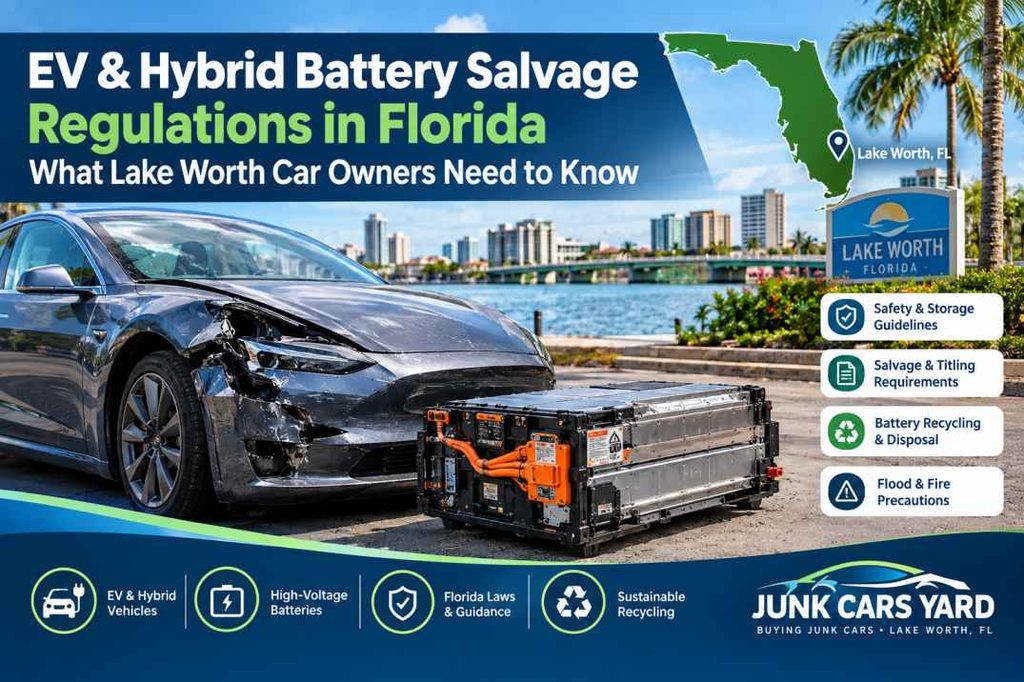
EV & Hybrid Battery Salvage Regulations in Florida
If you have an electric vehicle, hybrid, or plug-in hybrid that is wrecked, flooded, badly damaged, or no longer worth repairing, you may be wondering what happens to the battery and whether you can still sell the vehicle as a junk or salvage car.
The short answer is yes, damaged EVs and hybrids can have salvage value in Florida, but the traction battery and other high-voltage components make these vehicles different from traditional gas-powered junk cars. Florida law specifically recognizes several EV and hybrid components as major component parts, including the traction battery pack, electric traction motor, charge port, onboard charger, DC power converter, power electronics controller, and thermal system.
For vehicle owners in Lake Worth, Lake Worth Beach, Palm Beach County, and surrounding South Florida communities, understanding the rules can help you avoid unsafe handling, paperwork problems, and unrealistic expectations about what your damaged EV or hybrid is worth.
What Are EV & Hybrid Battery Salvage Regulations in Florida?
Florida’s salvage laws do not create a completely separate junk-car system just because a vehicle uses an electric or hybrid powertrain.
Instead, existing Florida motor-vehicle salvage requirements apply, while EVs and hybrids have additional components that Florida law specifically identifies as major component parts.
Under Florida Statute §319.30, major component parts for electric, hybrid, and plug-in hybrid vehicles include:
- Electric traction motor
- Electronic transmission
- Charge port
- DC power converter
- Onboard charger
- Power electronics controller
- Thermal system
- Traction battery pack
- Airbag
These components can be important when a damaged vehicle is being evaluated for salvage, dismantling, parts recovery, or recycling.
That means an EV sitting in a Lake Worth driveway with a damaged battery is not simply treated like an old gasoline vehicle with a dead engine.
The battery and high-voltage system need to be considered as part of the vehicle’s salvage condition.
Why EV Batteries Matter When Selling a Junk Car
With a conventional gasoline vehicle, a junk-car buyer may primarily look at the body, engine, transmission, catalytic converter, wheels, and scrap-metal value.
An EV or hybrid can be different.
The vehicle may contain valuable components such as:
- Traction battery pack
- Electric motor
- Power electronics
- Onboard charger
- DC converter
- Charge port
- Electronic transmission
- Thermal-management components
- Usable body and interior parts
At the same time, a damaged high-voltage battery can create additional handling and transportation considerations.
So the value of an EV is not necessarily determined by simply asking, “How much does the metal weigh?”
The condition and type of vehicle can matter considerably.
What Florida Law Says About EV and Hybrid Salvage Parts
Florida’s current statute is particularly important because it specifically includes EV and hybrid components in its definition of major component parts.
This matters for salvage businesses because Florida law contains documentation and recordkeeping requirements involving vehicles, major component parts, and salvage transactions.
For example, when a salvage motor vehicle dealer purchases materials or major component parts, §319.30 requires records including information about the seller, purchase date, and vehicle identification number when available.
In other words, an EV traction battery is not simply an ordinary used household battery.
It is part of a motor vehicle subject to Florida’s motor-vehicle salvage framework.
Can You Sell a Damaged EV or Hybrid in Lake Worth?
Yes.
A damaged EV or hybrid can potentially be sold for salvage, parts, or junk value depending on its condition, title status, battery condition, age, make, model, and other factors.
Common examples include:
- Wrecked Tesla vehicles
- Flood-damaged electric cars
- Hybrid vehicles with failed battery packs
- Plug-in hybrids involved in collisions
- Older EVs with expensive battery repairs
- Non-running hybrid cars
- Vehicles with severe body damage
- Cars with damaged charging systems
- Vehicles that are uneconomical to repair
If the vehicle has significant damage, tell the buyer exactly what happened.
For example, say whether the vehicle was:
“Flood damaged,” “collision damaged,” “battery fault,” “won’t start,” “charging problem,” or “non-running.”
That information helps a buyer determine whether the vehicle is suitable for parts recovery, salvage, recycling, or another disposition.
If you’re ready to sell an unwanted vehicle, you can start with our sell your junk car service.
What If the EV Has a Damaged or Flooded Battery?
This is where extra caution is important.
Lithium-ion batteries can become hazardous when damaged, defective, or involved in a serious incident.
Florida DEP currently provides specific resources concerning EV lithium-ion batteries and also directs businesses and the public toward U.S. Department of Transportation guidance concerning damaged, defective, or recalled lithium-ion batteries.
If an EV has been involved in:
- Flooding
- Fire
- Major collision
- Severe battery damage
- Battery swelling
- Significant underbody impact
- Other suspected high-voltage battery damage
don’t assume that it is safe to charge or operate simply because the vehicle still starts.
The safest approach is to tell the towing or salvage company about the vehicle’s condition before pickup.
Florida Does Not Have a Simple “EV Battery Junkyard Rule”
You may see online articles claiming that Florida has a specific statewide rule requiring every damaged EV to be stored a certain distance from buildings or that every EV battery must be handled under a particular new state program.
Be careful with those claims.
The current Florida statutes and Florida DEP materials establish requirements and guidance concerning salvage vehicles, batteries, hazardous-waste management, and transportation, but proposed legislation should not be presented as if it were already enacted law.
For example, Florida’s current §319.30 clearly establishes the treatment of EV and hybrid components as major component parts.
That’s different from saying that every proposal concerning EV battery storage or recycling is currently Florida law.
Is a Traction Battery Considered a Major Component Part?
Yes.
This is one of the most important points for EV and hybrid owners.
Florida Statute §319.30 expressly lists the traction battery pack as a major component part for electric, hybrid, and plug-in hybrid motor vehicles or trucks.
The same section also lists other EV-specific components, including:
Electric traction motor
The motor that provides electric propulsion.
Charge port
The component used to connect the vehicle to external charging equipment.
Onboard charger
The system responsible for converting incoming electrical power for charging the vehicle’s battery.
DC power converter
An important electrical component in the vehicle’s power system.
Power electronics controller
The electronics responsible for controlling electrical power within the vehicle.
Thermal system
The system involved in managing temperatures of relevant vehicle components.
Traction battery pack
The high-voltage battery system used to store energy for electric propulsion.
These aren’t merely generic descriptions; they are specifically included in Florida’s statutory definition.
How Does Battery Condition Affect an EV’s Salvage Value?
There isn’t one fixed Florida price for an EV battery or damaged electric vehicle.
A buyer may consider:
- Vehicle make
- Model
- Model year
- Battery type
- Battery condition
- Whether the battery was flooded
- Whether the battery was involved in a collision
- Mileage
- Overall vehicle condition
- Availability of usable parts
- Demand for replacement parts
- Title status
- Location
- Transportation requirements
- Scrap-metal value
A newer EV with an intact battery and extensive body damage could be evaluated very differently from an older hybrid with a failed battery.
That’s why online claims such as “every junk EV is worth $X” should be treated cautiously.
For a broader explanation of how junk-car prices can vary in South Florida, see our 2026 South Florida junk car value guide.
What About a Hybrid With a Dead Battery?
A dead hybrid battery does not automatically mean the entire vehicle has no value.
The vehicle could still contain usable:
- Body panels
- Doors
- Wheels
- Interior components
- Electronics
- Electric motors
- Transmission components
- Catalytic-converter-related components
- Other reusable parts
However, the condition of the battery and the rest of the vehicle can significantly affect how a buyer evaluates it.
A hybrid that does not start because of a battery problem should be described honestly when requesting a quote.
What About a Flood-Damaged EV in South Florida?
Flood damage deserves particular attention in South Florida.
Lake Worth and other Palm Beach County communities can experience heavy rainfall, storm flooding, and water exposure.
An EV that has been exposed to significant water should not automatically be treated as an ordinary non-running vehicle.
Water intrusion can affect:
- High-voltage battery components
- Electrical connections
- Control modules
- Charging equipment
- Motors
- Wiring
- Interior electronics
- Safety systems
If your vehicle was affected by a storm or flooding, explain the circumstances before arranging transportation.
You can also read our flood-damaged vehicle recovery guide for additional information about handling a damaged vehicle after severe weather.
Can a Junk Car Yard Pick Up an EV or Hybrid?
In many situations, yes, but the pickup should be arranged based on the vehicle’s actual condition.
Tell the buyer if the EV or hybrid:
- Does not start
- Cannot shift into neutral
- Has collision damage
- Has flood damage
- Has battery warnings
- Has visible battery damage
- Has been involved in a fire
- Has missing wheels
- Has been sitting for a long period
This is particularly important for towing.
A non-running gasoline car and a severely damaged EV may require different transportation considerations.
For a Lake Worth pickup, providing accurate information before the tow can help the company prepare appropriately.
What Paperwork Do You Need to Sell a Salvage EV?
The paperwork depends on the vehicle’s circumstances and title status.
Florida’s salvage statute contains specific requirements concerning certificates of title, salvage certificates of title, certificates of destruction, and derelict vehicles.
For a normal vehicle sale, you should have your ownership documents available and be prepared to provide accurate vehicle information.
If the vehicle has been declared a total loss, has a salvage title, or qualifies as a derelict vehicle, additional requirements may apply.
Don’t assume that an EV gets a special exemption from Florida’s title requirements because its battery is damaged.
What If You Don’t Have the Title?
A missing title does not necessarily mean you should abandon the sale, but the process can be different.
The correct procedure depends on:
- Whether you are the registered owner
- Whether a lien exists
- Whether the vehicle is considered salvage
- Whether the vehicle qualifies as a derelict
- Whether another ownership document exists
- Whether the vehicle is titled in Florida or another state
If you’re in Lake Worth and don’t have the title, explain the situation before arranging pickup rather than simply signing paperwork you don’t understand.
Lake Worth EV & Hybrid Salvage: What Local Owners Should Know
For someone living around Lake Worth, Lake Worth Beach, Palm Springs, Greenacres, Boynton Beach, Wellington, or West Palm Beach, an unwanted EV can become a practical problem quickly.
Maybe it is sitting in a driveway after a collision.
Maybe the repair estimate is higher than the vehicle’s value.
Maybe an older hybrid needs a battery replacement that doesn’t make financial sense.
Or perhaps a storm-damaged vehicle has been sitting unused.
Lake Worth neighborhoods such as Downtown Lake Worth, Bryant Park, Tropical Ridge, Parrot Cove, College Park, and Lake Osborne Heights have different types of residential properties and parking situations.
If a non-running vehicle is taking up valuable driveway or parking space, arranging removal can be more practical than leaving it sitting indefinitely.
Junk Cars Yard serves Lake Worth and surrounding South Florida areas and can evaluate junk, damaged, wrecked, and non-running vehicles.
You can also see our Lake Worth junk car information and local service for details about selling a vehicle and arranging pickup.
Can EV Batteries Be Recycled?
Yes, EV batteries can enter specialized recycling and recovery processes. Learn more about the EV and hybrid battery recycling boom and what it means for salvage values.
But EV traction batteries should not simply be treated like ordinary household rechargeable batteries.
Florida DEP’s current battery resources specifically point to an Electronic Vehicle Lithium-Ion Batteries FAQ and federal guidance for used and damaged lithium-ion batteries.
The appropriate handling route can depend on the battery’s condition and the type of business handling it.
A damaged or potentially hazardous battery may require additional precautions during transportation and processing.
This is one reason why telling a junk-car buyer about serious battery damage before pickup matters.
What Happens to an EV After It Reaches a Salvage Facility?
The process can vary depending on the vehicle.
A damaged EV or hybrid may be evaluated for:
- Vehicle identification and paperwork
- Overall condition
- Reusable parts
- Battery condition
- Major component parts
- Metal recovery
- Recyclable materials
- Salvage potential
Florida law also establishes documentation and recordkeeping requirements for licensed salvage motor vehicle dealers dealing with vehicles and major component parts.
The goal isn’t necessarily to send every vehicle directly to a crusher.
Depending on its condition, useful components may have another life as replacement parts or materials. Learn how salvage yards recycle wrecked vehicles and parts.
What EV Owners in Lake Worth Should Do Before Calling a Junk Car Buyer
Before scheduling pickup, gather:
- Vehicle year
- Make
- Model
- VIN if available
- Mileage
- Title or ownership documents
- Information about the battery
- Details about accident or flood damage
- Information about whether the vehicle starts
- Current location
- Any known mechanical or electrical problems
Also take a few clear photographs.
Useful photos include:
- Front
- Rear
- Driver side
- Passenger side
- Interior
- Dashboard
- Visible damage
- Battery warning messages
- Wheels/tires
- VIN plate
This can make the initial evaluation much easier.
How Junk Cars Yard Can Help With EVs and Hybrids in South Florida
Junk Cars Yard buys vehicles in a range of conditions, including junk, damaged, wrecked, and non-running vehicles.
For an EV or hybrid, the most important thing is to provide accurate information about the vehicle before pickup.
That includes telling us if the vehicle has:
- Battery problems
- Flood damage
- Collision damage
- Fire damage
- No-start condition
- Missing parts
- Severe underbody damage
We can then determine whether the vehicle is appropriate for our buying and removal process.
Our service is focused on Lake Worth and surrounding South Florida communities, including Palm Beach County areas.
EV & Hybrid Battery Salvage Regulations in Florida: Frequently Asked Questions
Are EV batteries considered major component parts in Florida?
Yes. Florida Statute §319.30 specifically lists the traction battery pack among the major component parts of electric, hybrid, and plug-in hybrid motor vehicles.
Can I sell a wrecked Tesla as a junk car in Florida?
Potentially, yes. Its value and the applicable paperwork depend on its condition, title status, battery condition, and other factors.
Can I sell a hybrid with a dead battery?
Yes, a dead hybrid battery does not automatically eliminate the vehicle’s salvage or parts value.
Is a damaged EV battery safe to handle like a normal car battery?
No assumption should be made that a damaged high-voltage lithium-ion battery can be handled like an ordinary automotive battery. Florida DEP provides specific EV lithium-ion battery resources and points to federal guidance concerning damaged lithium-ion batteries.
Does Florida have specific salvage rules for EVs?
Florida’s existing salvage framework specifically identifies EV and hybrid components as major component parts. Section 319.30 also establishes documentation, notification, and recordkeeping requirements for relevant salvage transactions.
Does a flooded EV have salvage value?
It can, but flood damage can significantly affect the vehicle’s condition and the handling requirements. Battery and electrical-system condition are particularly important.
Should I tell the junk car buyer that my EV battery is damaged?
Absolutely. Providing accurate information about serious battery, flood, fire, or collision damage allows the buyer and towing provider to prepare appropriately.
Can an EV be worth more than its scrap-metal value?
Yes. Depending on condition, usable components and salvage potential can contribute to the vehicle’s value.
Do I need a title to sell a junk EV in Florida?
The required documentation depends on the vehicle and its circumstances. Florida’s salvage statute contains specific requirements for titles, salvage titles, certificates of destruction, and certain derelict vehicles.
Final Takeaway for Lake Worth EV & Hybrid Owners
If you have a damaged EV, hybrid, or plug-in hybrid sitting in your driveway, don’t automatically assume that the vehicle is worthless because the battery is dead or the car no longer runs.
Florida law specifically recognizes EV and hybrid components such as the traction battery pack, electric traction motor, charge port, onboard charger, DC converter, power electronics controller, and thermal system as major component parts.
At the same time, damaged lithium-ion batteries require appropriate handling, and Florida DEP provides specific resources for EV battery management and damaged-battery transportation considerations.
For Lake Worth owners, the practical approach is simple:
Describe the vehicle accurately, disclose serious battery or flood damage, have your ownership paperwork ready, and get the vehicle evaluated based on its actual condition rather than assuming it has only scrap value.
If you have an unwanted EV, hybrid, wrecked car, or non-running vehicle in Lake Worth or the surrounding Palm Beach County area, Junk Cars Yard can help you determine the next step.
Junk Cars Yard
4096 S Military Trail
Lake Worth, FL 33463
Phone: 561-559-5865