
Selling a junk car usually starts with a simple question:
“How much will you pay me for it?”
But once you agree on a price, there is another question that deserves just as much attention:
“What paperwork do I need to complete after I sell it?”
That part is easy to overlook.
Maybe your old car has been sitting in the driveway in Lake Worth for two years. Maybe the engine finally gave out. Maybe you have a wrecked SUV that the insurance company considered too expensive to repair. Or maybe you simply have an older vehicle that you no longer want sitting on your property.
You find a buyer, arrange junk car pickup, hand over the vehicle and think the job is finished.
In Florida, there is still paperwork to take care of.
One of the most important documents to understand is HSMV 82050 — Notice of Sale and/or Bill of Sale for a Motor Vehicle, Mobile Home, Off-Highway Vehicle or Vessel.
Florida’s official form is used to document a vehicle sale, and Florida law establishes requirements for notifying the state after a bona fide sale or transfer. The law also provides circumstances in which a seller who has sold the vehicle and delivered possession is no longer treated as the owner for certain civil-liability purposes after meeting the statutory requirements.
That is why the Notice of Sale should not be treated as an optional piece of paperwork.
For junk car owners in Lake Worth, Lake Worth Beach, Palm Beach County and surrounding South Florida communities, understanding the process can make the vehicle sale much cleaner.
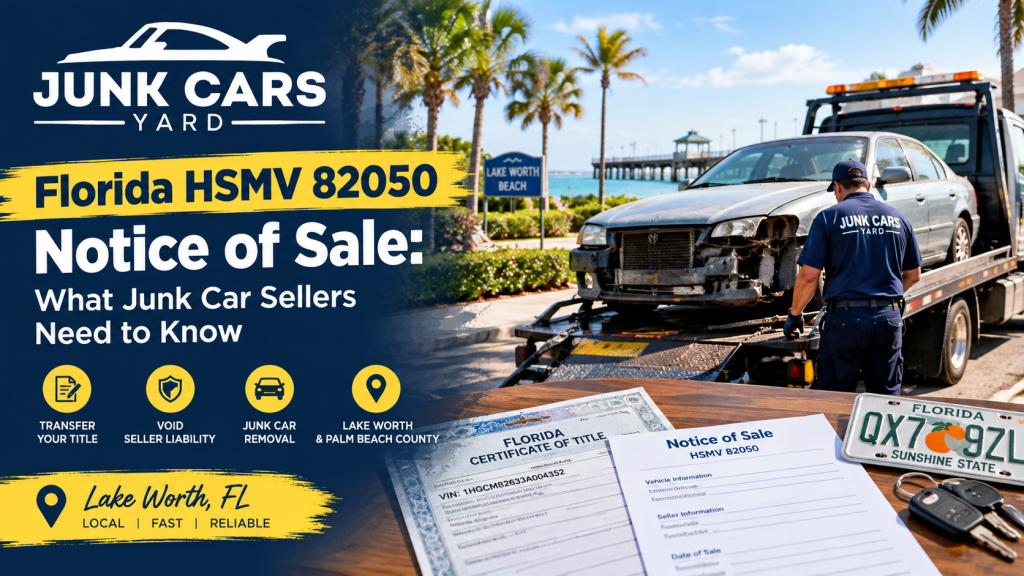
What is HSMV 82050?
HSMV 82050 is Florida’s official Notice of Sale and/or Bill of Sale form.
The current FLHSMV form says a seller using it as a Notice of Sale completes sections 1 and 3. The form records information about the vehicle, purchaser, sale date and selling price, along with the seller’s certification. The form also contains an odometer disclosure section for motor vehicles.
The vehicle information includes details such as:
- Year
- Make
- Model
- Body type
- Color
- Vehicle Identification Number (VIN)
- Certificate of title number
- Current title issue date
- Purchaser information
- Date of sale
- Selling price
- Odometer reading, when required
The form is more than a receipt.
It creates a documented record of the transaction.
And when you’re getting rid of a junk car, that record matters.
Does Florida require a Notice of Sale after selling a vehicle?
Yes, Florida law addresses notification after a bona fide sale or transfer.
Florida Statute §319.22 provides that when an owner or co-owner has made a bona fide sale or transfer and delivered possession to a purchaser, the seller can avoid being treated as the owner for certain civil-liability purposes when the statutory requirements are satisfied.
The statute specifically says the owner can meet one requirement by delivering the properly endorsed certificate of title or a notice in the form prescribed by the department. It also states that an owner or co-owner who has sold and delivered possession of a motor vehicle must notify the department within 30 days after the sale or transfer in the prescribed form, subject to the statute’s exceptions.
This is an important distinction.
The goal isn’t simply to say:
“I sold my car.”
The state needs a properly documented transaction.
Does HSMV 82050 automatically cancel all seller liability?
No.
This is one part of the topic where online articles can oversimplify Florida law.
You may see statements saying:
“File HSMV 82050 and you have zero liability.”
That is too broad.
Florida Statute §319.22 provides a specific protection concerning whether the seller is deemed the owner for civil liability for operation of the vehicle after the sale, provided the statutory requirements are met.
That is different from saying that a Notice of Sale provides blanket immunity from every possible legal, financial or administrative problem.
So, if you are a Lake Worth vehicle owner selling a junk car, the better way to think about HSMV 82050 is:
It helps create the official record that you sold and delivered the vehicle, and Florida law provides specific liability protections when the statutory requirements are satisfied.
That’s much more accurate.
Is the Florida Notice of Sale electronic?
This is another area where terminology can get confusing.
The topic is sometimes described as an “FLHSMV electronic Notice of Sale requirement.”
However, the official HSMV 82050 form currently available from FLHSMV says:
“SUBMIT THIS FORM TO YOUR LOCAL TAX COLLECTOR OFFICE.”
FLHSMV’s TL-52 procedure likewise instructs the seller to submit an accurately completed HSMV 82050, or the applicable Notice of Sale section on the title, to the tax collector’s office or license plate agent so the title record can be marked as sold.
So I would not tell Florida junk-car sellers that every private vehicle sale requires them to log into an online portal and electronically submit HSMV 82050.
The more accurate description is:
Florida Notice of Sale requirements use the HSMV 82050 form, with submission handled according to FLHSMV procedures.
That’s the wording I would use on a business website because it is based on the official state documents rather than an assumption about an electronic filing system.
Why does this matter when selling a junk car?
A junk car may look like a completely different transaction from selling a normal used vehicle.
The vehicle might not run.
It might have a blown transmission.
The front end might be damaged from an accident.
It could have significant rust.
It might be missing parts.
Or it could be headed straight to a salvage operation for dismantling, reusable components and recycling.
But if you are selling the vehicle, the fact that it is a junk car doesn’t mean you should ignore the paperwork.
Consider a typical Lake Worth situation.
An older sedan has been sitting behind a house near the 33460 area. The owner hasn’t driven it in months. The battery is dead, the tires are flat and the repair estimate is more than the owner wants to spend.
A junk car buyer agrees to purchase it.
A tow truck arrives.
The car leaves the property.
At that point, the owner might feel like the entire process is over.
But the physical removal of the vehicle and the legal/documentary side of the transaction are two separate things.
The tow truck leaving does not replace the paperwork.
What information should be recorded?
A good vehicle sale record should clearly identify the vehicle and the transaction.
HSMV 82050 includes fields for important information such as the vehicle identification number, title information, purchaser, date of sale and selling price. It also includes the applicable odometer disclosure for a motor vehicle.
That means sellers should take a few minutes to check the details before signing.
Check the VIN
Make sure the VIN on the paperwork matches the actual vehicle.
A VIN is one of the most important identifiers associated with a vehicle.
Check the buyer information
Make sure the purchaser’s information is entered correctly.
Check the sale date
The transaction should have a clear date.
Check the selling price
Make sure the amount recorded reflects the actual transaction.
Check the title
Don’t assume the Notice of Sale itself replaces the title-transfer process.
Check the odometer information
When an odometer disclosure is required, make sure the reading and certification are completed accurately.
The official HSMV 82050 specifically warns that federal and state law requires mileage to be stated in connection with the transfer of ownership and that false or incomplete odometer information can carry consequences.
Does HSMV 82050 transfer ownership?
No.
This is another important distinction for Florida vehicle sellers.
The HSMV 82050 form itself states that ownership status will not change until the purchaser applies for and is issued a certificate of title.
Florida Statute §319.22 similarly establishes the importance of the certificate of title in establishing marketable title.
So think about the documents as serving different purposes.
Title transfer: establishes the ownership record.
Notice of Sale: documents that the vehicle was sold/transferred and provides information to the state.
Bill of Sale: documents the transaction between seller and purchaser.
License plate removal: handles the registration plate as required by Florida law.
They work together, but they are not interchangeable.
Don’t forget the Florida license plate
Selling a junk car is not just about the title.
Florida Statute §320.271 states that when a used or secondhand motor vehicle is sold and delivered, the registration license plate must be removed before ownership is transferred and the vehicle is delivered to the purchaser.
That means a seller should not simply watch the tow truck take the vehicle away with an active Florida plate still attached.
If you’re selling an old vehicle from a driveway in:
- Downtown Lake Worth
- Bryant Park
- Tropical Ridge
- Parrot Cove
- College Park
- Lake Osborne Heights
- Lake Worth Beach
- Greenacres
- Palm Springs
- Lantana
- Boynton Beach
- Wellington
- Royal Palm Beach
the same Florida state requirements apply.
Local pickup doesn’t change the state paperwork.
What if my junk car doesn’t run?
That’s not necessarily a problem.
A junk car doesn’t have to be roadworthy to be sold.
Owners may be looking to sell:
- Non-running cars
- Wrecked vehicles
- Accident-damaged cars
- Vehicles with blown engines
- Cars with transmission failure
- Old trucks
- Damaged SUVs
- Flood-damaged vehicles
- Rusted vehicles
- High-mileage vehicles
- Vehicles with missing parts
A tow truck can remove a vehicle that cannot be driven.
But again, vehicle condition and paperwork are two different issues.
A car being worth only salvage or scrap value does not eliminate the need to properly document its sale.
What if I’m selling the car for parts or recycling?
This is where the words “junk car,” “salvage vehicle” and “scrapped vehicle” can sometimes cause confusion.
A vehicle can be sold to a buyer who intends to dismantle it, recover usable components or recycle its materials.
Florida also has separate procedures involving vehicles that are formally declared junk or processed through salvage/title procedures.
So don’t assume that saying “I’m scrapping my car” automatically means the same thing legally as every other vehicle transaction.
If your vehicle has a salvage title, has been declared junk, or has a complicated ownership history, check the applicable FLHSMV requirements before completing the transaction.
For a straightforward unwanted-car sale, however, the seller should still document the transaction and follow the applicable title and Notice of Sale requirements.
Lake Worth junk car sellers should keep a copy of their records
This is one of the simplest pieces of advice we can give.
Keep your paperwork.
Don’t throw away the documents immediately after the car leaves.
Keep your records showing:
- Vehicle identification
- VIN
- Purchaser information
- Sale date
- Sale price
- Title paperwork
- Notice of Sale
- Bill of Sale, if applicable
- Other documents associated with the transaction
You may never need them again.
But if you ever need to establish when a vehicle was sold, having a clear record is much better than trying to reconstruct the transaction months later.
What if I lost the title?
This is a different situation and should be handled separately.
A missing title can create additional questions about ownership, liens and how the vehicle can legally be transferred.
If you’re in Lake Worth and have a junk car without its title, don’t simply assume the buyer can ignore the title problem.
We have a separate guide covering:
How to Sell a Junk Car Without a Title in Lake Worth, FL
That article can go deeper into the title issue without making this Notice of Sale article unnecessarily complicated.
A simple HSMV 82050 checklist for Lake Worth sellers
If you’re getting ready to sell an unwanted vehicle, here’s the process I’d keep next to the paperwork.
Before the pickup
1. Find the title.
Make sure you know where the vehicle title is and check whether there is a lien or other ownership issue.
2. Locate the VIN.
Verify that the VIN matches the vehicle and your documents.
3. Confirm the buyer.
Know who is purchasing the vehicle and make sure the purchaser information is accurate.
4. Agree on the sale price.
Have a clear understanding of the amount being paid.
During the transaction
5. Complete the required title paperwork.
Don’t sign incomplete documents or leave important information blank.
6. Complete HSMV 82050 when applicable.
Use the official FLHSMV Notice of Sale/Bill of Sale form and follow the state’s submission instructions.
7. Record the sale date.
Make sure the date reflects the actual transaction.
8. Handle the odometer disclosure when required.
Don’t guess at the mileage or provide inaccurate information.
9. Remove the license plate.
Florida law requires removal before transfer and delivery of a used or secondhand vehicle.
After the vehicle leaves
10. Keep your records.
Save your paperwork and evidence of the completed transaction.
That’s it.
It doesn’t have to be complicated.
Why this is especially useful for junk car owners
Most people don’t spend their weekends reading Florida motor vehicle statutes.
They just want the old car gone.
A vehicle sitting in a driveway in Lake Worth’s 33460, 33461 or 33467 ZIP codes can become a headache when it no longer runs or isn’t worth repairing.
Maybe the owner is preparing to move.
Maybe the vehicle is taking up space.
Maybe an accident left the car beyond economical repair.
Maybe the owner is tired of paying insurance and registration costs on a vehicle that isn’t being used.
Whatever the reason, the goal is usually the same:
Sell the vehicle, have it removed, and finish the transaction properly.
That’s why the Notice of Sale is worth understanding.
Can a junk car buyer help with the paperwork?
A legitimate buyer may explain the paperwork involved in the transaction, but sellers should still understand what they’re signing.
Don’t sign a blank document.
Don’t guess at the VIN.
Don’t leave the buyer’s information incomplete.
Don’t assume the title and Notice of Sale are the same document.
And don’t assume that because a vehicle is being sold for scrap value, the normal documentation suddenly doesn’t matter.
If you’re selling a junk car in Lake Worth, the physical part may be simple: agree on a price, schedule pickup and have the vehicle removed.
The paperwork deserves the same level of attention.
At Junk Cars Yard, we focus on unwanted, damaged, wrecked and non-running vehicles and junk car removal in Lake Worth and surrounding Palm Beach County communities. For the seller, the ideal transaction is one where the vehicle is removed and the paperwork is handled clearly.
Frequently Asked Questions
What is HSMV 82050?
HSMV 82050 is Florida’s official Notice of Sale and/or Bill of Sale form for a motor vehicle, mobile home, off-highway vehicle or vessel. The current FLHSMV form provides fields for vehicle, purchaser, sale and odometer information.
Is a Notice of Sale required after selling a junk car in Florida?
Florida Statute §319.22 establishes a notice requirement after a bona fide sale or transfer of a motor vehicle, subject to the statute’s exceptions. The statute states that the owner must notify the department within 30 days in the prescribed form.
Does HSMV 82050 automatically cancel my liability?
No. It should not be described as blanket protection from every possible liability. Florida law provides specific protection concerning whether a seller is treated as the owner for certain civil-liability purposes after a bona fide sale and delivery of possession when the statutory requirements are fulfilled.
Do I need to file HSMV 82050 electronically?
The official HSMV 82050 form instructs the seller to submit the form to the local tax collector’s office, while FLHSMV’s TL-52 procedure refers to submission to a tax collector’s office or license plate agent. The official sources reviewed do not establish a universal online electronic filing requirement for every private junk-car sale.
Do I remove my Florida license plate when selling a junk car?
Yes. Florida Statute §320.271 requires the registration license plate to be removed from a used or secondhand motor vehicle before transferring ownership and delivering it to the purchaser.
Does HSMV 82050 transfer ownership?
No. The form states that ownership status does not change until the purchaser applies for and receives a certificate of title.
Can I sell a non-running car in Lake Worth?
A vehicle does not have to be running to be a potential junk, salvage or damaged-vehicle sale. However, the applicable title, Notice of Sale and registration requirements still need to be addressed.
Final Word: Don’t Forget the Paperwork
When you’re selling a junk car, it’s easy to focus on the cash.
That’s understandable.
But the transaction doesn’t end just because the tow truck drives away.
For Florida vehicle owners, HSMV 82050 is an important document to understand when documenting a vehicle sale. Florida law also provides specific requirements for notifying the state after a bona fide sale or transfer and specific circumstances in which completing those requirements limits how the seller is treated as the vehicle’s owner for later civil-liability purposes.
So before your old car leaves your Lake Worth driveway, take a few minutes to make sure the paperwork is right.
Check the VIN.
Check the buyer information.
Check the sale date.
Handle the title properly.
Complete the Notice of Sale when applicable.
Remove the license plate.
Keep your records.
Then let the tow truck do its job.
The car may be junk, but the paperwork shouldn’t be.