
If you live in Lake Worth Beach, Lake Worth, Palm Springs, Lantana, Hypoluxo, Boynton Beach, or another coastal Palm Beach County community, you probably already know that living near the Atlantic comes with a few trade-offs.
Beautiful beaches.
Warm weather.
Ocean breezes.
And, eventually, a little more rust than you might expect.
For vehicles, the coastal environment can be particularly unforgiving. Salt in the air, moisture, humidity, standing water and occasional coastal flooding can all create conditions where corrosion becomes a problem.
That does not mean every car parked near the beach is going to rust away.
It also does not mean a rusty vehicle automatically belongs in a junkyard.
But if you have an older vehicle that has spent years around the coast, especially one that has also experienced flooding or prolonged exposure to moisture, it is worth looking underneath the car—not just at the paint.
And this is where things can get interesting for Lake Worth car owners.
A vehicle that looks reasonably good from the driver’s seat can sometimes have substantial deterioration underneath.
That can affect suspension components, brake lines, exhaust components, fasteners, frame areas and other metal parts.
For someone deciding whether to repair, keep, sell or junk an older vehicle, the condition underneath the car can be just as important as what you see from the outside.
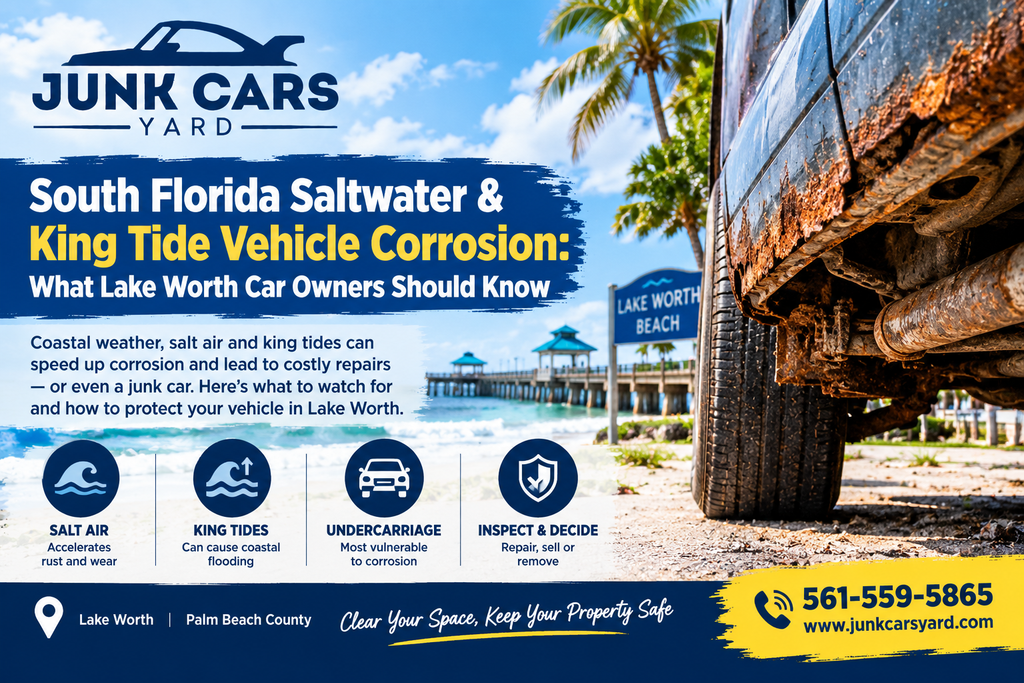
Why Is South Florida Hard on Vehicles?
South Florida has a combination of environmental conditions that can be tough on metal.
The Atlantic Ocean is right next to communities such as Lake Worth Beach, and the coastal environment contains salt and moisture.
Salt matters because dissolved salts make water a better electrolyte, which can accelerate electrochemical corrosion of metals. NOAA materials describe the relationship between salts, moisture and corrosion, while NOAA coastal research also identifies corrosion as an important concern in Southeast Florida’s coastal environment.
For a vehicle owner, you don’t need to understand electrochemistry to notice the result.
You may eventually see:
- Surface rust
- Flaking metal
- Corroded bolts
- Rust around suspension components
- Exhaust deterioration
- Brake-line corrosion
- Rust around body seams
- Corroded electrical connections
- Undercarriage deterioration
- Rust around fasteners and brackets
And the problem is not necessarily limited to cars parked directly beside the ocean.
Salt-laden air and moisture can affect vehicles throughout coastal communities.
That’s why an older car in 33460 or 33461 can have a very different corrosion history from an otherwise identical vehicle that spent most of its life in a dry inland environment.
What Does Salt Air Actually Do to a Car?
Think about what happens after you visit the beach.
Sand gets everywhere.
Moisture gets everywhere.
Salt gets on things you didn’t even realize were exposed.
A vehicle has hundreds of places where moisture can collect or where metal surfaces are exposed.
The undercarriage is particularly important.
Unlike the hood or roof, the underside of the vehicle isn’t something most owners inspect regularly.
There are suspension arms, subframes, exhaust components, brake components, shields, brackets, fasteners and other metal parts underneath.
Over time, moisture and salt deposits can contribute to corrosion.
NOAA technical material on marine corrosion notes that saltwater environments can produce both general corrosion and localized corrosion, including pitting.
That distinction matters.
A little orange surface rust on an otherwise healthy component isn’t necessarily the same thing as significant structural deterioration.
That’s why “my car has rust” isn’t enough information to determine whether the vehicle is still worth repairing.
You have to know where the rust is and how severe it is.
The Undercarriage Is Where Lake Worth Car Owners Should Look
If you own an older vehicle in South Florida, don’t judge its condition solely by looking at the doors, hood and roof.
Take a look underneath.
Or have a qualified mechanic inspect it.
Pay particular attention to:
1. Frame and structural areas
On vehicles with significant corrosion, structural metal deserves careful inspection.
Rust that affects a cosmetic bracket is one thing.
Deterioration affecting an important structural component is a completely different concern.
2. Brake lines
Brake lines are another area where corrosion deserves attention.
A vehicle can look fine externally while metal components underneath have deteriorated.
3. Suspension components
Look for excessive rust, scaling, cracking or other signs of deterioration around suspension components and mounting areas.
4. Exhaust system
Exhaust components live underneath the vehicle and are exposed to moisture, road debris and temperature changes.
Rust holes and deteriorated exhaust components are common reasons older vehicles need repairs.
5. Fasteners and hardware
This sounds minor until someone tries to remove a rusted component.
Severely corroded bolts, nuts and fasteners can make an otherwise straightforward repair considerably more difficult.
6. Electrical connections
Moisture and corrosion can also create electrical problems, particularly where connectors, terminals or wiring have been exposed to water.
What Do King Tides Have to Do With Vehicle Damage?
This is where South Florida’s coastal geography becomes especially relevant.
King tides are unusually high tides that can produce coastal or “sunny day” flooding even when there is no rain.
Palm Beach County explains that king tides typically occur in Florida during the fall and recommends monitoring NOAA tide predictions for the Lake Worth tide gauge. The county notes that some locations can experience flooding even below the official flood stage.
NOAA also explains that king tides commonly occur around spring and fall and can contribute to recurrent coastal flooding. High-tide flooding can expose infrastructure to saltwater and contribute to deterioration.
Lake Worth has something particularly useful for monitoring local conditions:
NOAA’s Lake Worth Pier tide station.
The NOAA station is located at Lake Worth Pier, Atlantic Ocean, Florida, and records water levels and tide information for the area.
That gives local residents a useful reference when unusually high tides are expected.
Why Lake Worth Beach Is Different From Inland Lake Worth
This is an important distinction.
Lake Worth Beach is directly connected to the Atlantic coastal environment.
The William O. Lockhart Municipal Pier, commonly known as the Lake Worth Beach Pier, extends into the Atlantic Ocean from the city’s oceanfront area. NOAA operates a tide station at the pier.
That doesn’t mean a car parked miles away will experience the same exposure as a vehicle sitting next to the beach.
Local conditions vary.
But the closer a vehicle is to the coastal environment, the more relevant salt air, humidity, coastal flooding and storm-related water exposure can become.
For someone living around:
- Lake Worth Beach
- Downtown Lake Worth
- Bryant Park
- Parrot Cove
- Tropical Ridge
- Lake Osborne Heights
- Palm Beach
- Lantana
- Hypoluxo
- South Palm Beach
the vehicle’s history matters.
A 15-year-old vehicle that has spent most of its life in South Florida may have a very different undercarriage condition than a 15-year-old vehicle from a dry inland climate.
Saltwater Exposure Is More Serious Than Ordinary Rain
Rainwater and seawater aren’t the same thing.
Saltwater contains dissolved salts that can increase conductivity and contribute to corrosion.
That’s why a vehicle that has actually been exposed to saltwater flooding deserves special attention.
And there is another important distinction:
Coastal air exposure is not the same thing as submersion.
A vehicle that has spent years near the ocean may develop gradual corrosion.
A vehicle that has been flooded with saltwater can experience a much more serious combination of mechanical, electrical, interior and corrosion-related problems.
Florida’s vehicle-title system recognizes water and flood damage as significant vehicle history. FLHSMV procedures specifically address vehicles with “Water Damage” or “Flood Damage” branding.
So if a car has actually been flooded, don’t treat it as simply “an old rusty car.”
Its history matters.
Can Saltwater Corrosion Make a Car a Junk Car?
It can contribute to that decision, but corrosion alone doesn’t automatically make a vehicle a junk car.
This is an important distinction.
Suppose you have a 2017 sedan with a little surface rust underneath.
That doesn’t mean you should junk it.
Now imagine an older vehicle with:
- Severe underbody corrosion
- Multiple mechanical problems
- Electrical issues
- Brake-line deterioration
- Exhaust damage
- Suspension problems
- A failing engine or transmission
- Extensive body rust
- Water or flood history
At some point, the repair estimate may become difficult to justify.
That’s when getting a junk-car or salvage quote can make sense.
The decision should be based on the whole vehicle, not simply the amount of visible rust.
What About a Car Near the Lake Worth Beach Pier?
This is where I would be careful as a vehicle owner.
Don’t assume:
“It is near the beach, so it must be junk.”
And don’t assume:
“It still looks good, so there can’t be a problem.”
Neither conclusion is reliable without an inspection.
The Lake Worth Beach oceanfront is a heavily used coastal area, and the city is currently studying the future of its Municipal Beach Complex, including the beach, pier, parking areas and related infrastructure. The city describes coastal resilience and environmental factors as part of that broader planning process.
For vehicles, the practical takeaway is simpler:
If your car has spent years in the coastal environment, inspect the underside before making a major repair decision.
That is especially true if the vehicle has also been exposed to flooding.
How to Tell Whether Your Rusty Car Is Still Worth Repairing
This is probably the question most vehicle owners actually want answered.
There isn’t one universal dollar amount.
Instead, look at several factors.
Age
An older vehicle with extensive corrosion may require a different repair strategy than a newer vehicle with minor surface rust.
Mileage
High mileage combined with corrosion and major mechanical problems can change the economics of keeping the vehicle.
Mechanical condition
Does the engine run?
Does the transmission work?
Are there major oil leaks?
Does the vehicle have electrical problems?
Structural condition
This is one of the most important considerations.
Significant deterioration in structural areas deserves professional attention.
Repair estimate
Get the actual numbers.
A vehicle that needs $1,000 of routine work is a very different proposition from one that needs $7,000 in mechanical and corrosion-related repairs.
Vehicle value
Compare the repair cost with the realistic value of the vehicle in its current condition and after repair.
Parts availability
An older vehicle with valuable or difficult-to-find components may have salvage value even if repairing the entire vehicle doesn’t make financial sense.
Signs You May Want a Junk Car Quote Instead
Consider getting a quote if your vehicle has reached the point where several problems are piling up.
For example:
“The car runs, but the undercarriage is heavily rusted.”
“The engine needs major work and the body is already deteriorating.”
“The car was flooded and now has electrical problems.”
“The vehicle has been sitting for years and won’t start.”
“The repair estimate is higher than what I want to put into the car.”
These are reasonable situations in which a junk-car buyer can provide another option.
You don’t have to decide immediately.
You can compare:
repair cost → vehicle value → salvage/junk value → convenience of removal
That gives you a much clearer picture.
What Happens to a Saltwater-Damaged Car After You Sell It?
This is where the salvage industry becomes more interesting than many vehicle owners realize.
A junk car isn’t necessarily just crushed immediately.
Depending on its condition and the buyer’s operation, the vehicle may be evaluated for reusable components.
Potentially recoverable parts can include:
- Engine components
- Transmission
- Alternator
- Starter
- Wheels
- Interior components
- Electronics
- Body panels
- Suspension components
- Other usable parts
Vehicles that aren’t practical to repair may still contain components with reuse value.
The remaining vehicle can then move into the recycling process.
This is one reason a damaged or heavily corroded vehicle can still have value.
Our guide to used auto parts and vehicle salvage explains more about how reusable automotive components fit into the salvage process.
Saltwater Corrosion vs. Flood Damage: They Are Not the Same
This deserves its own section because people often use the terms interchangeably.
Coastal corrosion
This generally refers to gradual deterioration associated with exposure to moisture, salt-laden air and the coastal environment.
It can develop over years.
Flood damage
This occurs when water enters areas of the vehicle that normally remain dry.
Flooding can affect:
- Electrical systems
- Wiring
- Modules
- Interior
- Engine components
- Transmission
- Bearings
- Sensors
- Connectors
And if the water contains salt, the corrosion implications can be more serious.
Florida’s title procedures specifically address water-damaged and flood-damaged vehicles, including branding requirements in applicable circumstances.
So if you’re buying, selling or evaluating a flood-damaged vehicle, documentation matters.
What Should You Do After Your Vehicle Goes Through Floodwater?
First, don’t assume that because the engine starts, the vehicle is fine.
And don’t repeatedly attempt to start a vehicle that has been submerged or significantly flooded without having it evaluated.
Flood exposure can create problems that don’t appear immediately.
If the vehicle is already severely damaged or has substantial pre-existing corrosion, it may be worth getting a repair estimate and comparing that with the vehicle’s current salvage value.
If you ultimately decide to sell it, be straightforward about its condition and history.
That protects everyone involved in the transaction.
Why Older Cars in 33460, 33461 and 33463 Deserve a Closer Look
Lake Worth is not one uniform automotive environment.
A vehicle in 33460 near the downtown and beach-side areas can have a different exposure history from a vehicle farther inland.
The same is true for vehicles around 33461 and 33463.
That’s why ZIP code alone doesn’t determine whether a car is rusty or damaged.
What matters is the vehicle’s history.
Ask:
- How long has it been in South Florida?
- Has it lived near the coast?
- Has it been parked outdoors?
- Has it been exposed to flooding?
- Has it been washed regularly?
- Has the undercarriage been inspected?
- Has it had previous collision damage?
- Has it been sitting unused?
- Has corrosion already caused mechanical problems?
Those questions tell you much more than simply saying, “It’s a Florida car.”
A Simple South Florida Vehicle Corrosion Checklist
If you’re concerned about your older vehicle, here’s a practical starting point.
Exterior
Look for:
- Bubbling paint
- Rust around wheel arches
- Rust at door bottoms
- Corrosion around seams
- Peeling paint
- Rust around the trunk or hood
Underneath
Look for:
- Heavy scaling
- Flaking metal
- Corroded exhaust
- Rusted brake components
- Damaged brackets
- Suspension corrosion
- Structural deterioration
Inside
Check for:
- Damp carpet
- Musty smell
- Water stains
- Mold
- Corrosion around electrical components
Mechanical
Watch for:
- Starting problems
- Electrical glitches
- Warning lights
- Brake problems
- Suspension noise
- Exhaust leaks
- Unusual fluid leaks
If several categories show problems at the same time, it may be time to compare repair costs against the vehicle’s salvage or junk value.
Does Washing Your Car Help Prevent Salt Corrosion?
Regular cleaning can help remove accumulated salt and road contaminants from the vehicle.
The undercarriage is particularly important.
If you live close to the coast and drive near the beach regularly, an occasional underbody rinse can be useful as part of normal vehicle care.
But cleaning cannot reverse metal that has already deteriorated.
Once corrosion has caused substantial material loss, the solution is no longer simply “wash the car.”
That’s when an inspection matters.
What About King Tides in Lake Worth?
King tides are particularly relevant during Florida’s fall high-tide cycles.
Palm Beach County provides a king-tide resource and points residents toward NOAA’s Lake Worth tide gauge to monitor predicted water levels.
NOAA’s Lake Worth Pier station provides local tide observations and predictions for the Atlantic location.
The National Weather Service also notes that South Florida can experience tidal flooding during high-tide cycles, particularly along vulnerable areas near the Intracoastal Waterway.
For vehicle owners, that means something practical:
If flooding is occurring, don’t treat a flooded roadway like an ordinary wet road.
The National Weather Service warns drivers not to assume a water-covered roadway is safe to cross.
A few extra minutes of waiting can be preferable to putting a vehicle into water deep enough to cause expensive damage.
When a Rusty Car Becomes a Junk Car
There isn’t a single moment when a vehicle officially becomes a “junk car.”
It’s usually a combination of factors.
A car can be considered a practical junk-car candidate when the cost, condition and effort required to keep it on the road no longer make sense for the owner.
For one person, that might be an engine failure.
For another, it could be severe undercarriage corrosion.
For someone else, it could be a flood-damaged vehicle with electrical problems.
And sometimes it’s simply:
“I don’t want to keep putting money into this car.”
That’s a legitimate reason to investigate its salvage value.
Selling a Corroded or Damaged Car in Lake Worth
If you decide to sell, start by gathering your vehicle information.
Have the:
- Year
- Make
- Model
- VIN
- Mileage
- Title information
- General condition
- Location
available.
Be honest about whether the vehicle:
- Runs
- Starts
- Has severe rust
- Has flood history
- Has missing parts
- Has collision damage
- Has mechanical problems
A buyer can then determine whether the vehicle is suitable for junk, salvage, parts or another disposition.
If you’re comparing offers, our guide on how to get the most cash for your junk car can help you understand the factors that influence an offer.
You can also read our guide on where to sell a junk car in Lake Worth.
What If the Car Doesn’t Run?
That’s not necessarily a problem.
A non-running vehicle can still have salvage value.
The important part is making sure the buyer knows it doesn’t run before arranging pickup.
Tell them if:
- The engine is seized
- The transmission doesn’t work
- The wheels don’t roll
- The tires are flat
- The vehicle has been sitting
- The keys are missing
- The car is behind a gate
- The vehicle has severe undercarriage corrosion
This allows the correct equipment to be arranged.
For Lake Worth owners dealing with an unwanted non-running vehicle, our junk car removal service can be a practical alternative to paying separately for a tow.
Does a Rusty Car Still Have Value?
Absolutely—but the amount depends on the vehicle.
A heavily corroded car can still contain:
- Aluminum
- Steel
- Copper
- Catalytic components
- Wheels
- Mechanical parts
- Interior components
- Reusable parts
The vehicle’s make, model, year, completeness and condition can all influence its value.
That’s why it is better to get an actual quote than assume a rusty car is worthless.
Frequently Asked Questions
Does salt air make cars rust faster in South Florida?
Salt and moisture can contribute to corrosion because dissolved salts increase the conductivity of water and can accelerate electrochemical corrosion. Coastal exposure is therefore an important consideration for vehicles in South Florida.
Does living near Lake Worth Beach increase the risk of vehicle corrosion?
Coastal exposure can increase corrosion risk compared with a dry inland environment, particularly when vehicles are regularly exposed to salt-laden air and moisture. However, the actual condition of an individual vehicle depends on its history, storage, maintenance and exposure.
Can king tides damage a parked car?
King tides can cause coastal or sunny-day flooding in vulnerable areas. If a vehicle is exposed to floodwater, particularly saltwater, damage can extend beyond ordinary surface corrosion. Palm Beach County and NOAA provide local tide and flooding information for the Lake Worth area.
Is surface rust enough to junk a car?
No. Surface rust alone doesn’t determine whether a vehicle is a junk car. The location and severity of corrosion, along with mechanical condition, structural integrity, repair costs and vehicle value, should be considered.
Can a flood-damaged vehicle be sold?
Flood-damaged vehicles can be sold, but their condition and title history matter. Florida has specific procedures concerning water-damaged and flood-damaged vehicles, including applicable title branding requirements.
Can I sell a rusty car for cash in Lake Worth?
Yes. A rusty or damaged vehicle may still have salvage, parts and scrap value. The actual amount depends on the individual vehicle and its condition.
Can I sell a non-running car?
Yes. Non-running cars are commonly evaluated as junk or salvage vehicles. Pickup arrangements depend on the vehicle’s location and condition.
Should I repair a heavily rusted car or sell it?
Compare the repair estimate with the vehicle’s realistic value, remaining useful life and salvage value. If significant corrosion is combined with expensive mechanical problems, getting a junk-car quote can provide another number to consider before spending money on repairs.
Final Takeaway for Lake Worth Car Owners
South Florida’s coastal environment is part of what makes the region special.
It is also something your vehicle has to live with.
Salt-laden air, humidity, moisture and coastal flooding can all contribute to deterioration over time. NOAA research documents the relationship between salt, moisture and corrosion, while Palm Beach County and NOAA provide local resources for monitoring king tides and coastal water levels around Lake Worth.
But don’t look at an old car and automatically assume “rust = junk.”
Look underneath.
Check the mechanical condition.
Consider the repair bill.
Consider the vehicle’s history.
And if the car has reached the point where repairing it no longer makes financial sense, compare that cost with what the vehicle could bring as a junk or salvage vehicle.
For homeowners in Lake Worth, Lake Worth Beach, Palm Beach County and surrounding South Florida communities, that can turn an unwanted rusty car from a driveway problem into a relatively straightforward decision.
If your vehicle is damaged, non-running, heavily rusted or simply no longer worth keeping, you can also read our Lake Worth junk car selling guide or learn how much a junk car may be worth in South Florida.
Junk Cars Yard buys unwanted, damaged and non-running vehicles in Lake Worth and surrounding Palm Beach County communities and can arrange vehicle pickup.